Beyond the Human Eye
Human visual inspectors suffer eye strain after 30 minutes, allowing hairline cracks and dimensional flaws to slip through to Tier-1 OEM buyers. Discover how high-speed edge Visual AI inspects 120 parts per minute, eliminating customer debit notes and export batch rejections.
1. The Operational Challenge: The Exhausted Human Inspector on the Shop Floor
Step into any precision manufacturing plant or packaging line in Chakan (Pune), Manesar (Haryana), or Peenya (Bengaluru) at 3:30 PM during the second shift:
A conveyor belt moves steadily at 90 units per minute. Two quality inspection workers sit under harsh fluorescent lighting, staring intently at every passing component: looking for hairline casting cracks, missing O-rings, incomplete thread tappings, or slightly misaligned bottle caps.
The human eye is an incredible biological organ, but it was not designed to inspect 50,000 identical steel components or blister packs under factory noise and vibration:
[Production Shift Begins] ──► 98% Human Accuracy (First 30 Minutes)
            │
            ▼ (Fatigue, Eye Strain, Micro-Distractions)
[After 2.5 Hours]         ──► Accuracy Plummets to 74%
            │
            ▼ (Defective parts slip through to packaging)
[End of Shift]            ──► Batches Shipped to Tier-1 OEM or Export Port
2. Why Traditional Sensor Systems Fall Short
Many manufacturing plant heads have tried mechanical sensors or legacy optical photoelectric proximity switches. While useful for simple presence detection, traditional sensors fail on complex visual quality challenges:
| Quality Challenge | Legacy Optical / Mechanical Sensors | Modern Visual AI Inspection Systems |
|---|---|---|
| Micro Surface Cracks & Pitting | Cannot detect surface defects or hairline scratches | Detects sub-millimeter scratches down to 0.05mm |
| Varied Component Orientations | Errors out if the part rotates or enters at an angle | Omni-directional recognition; inspects parts in any position |
| Complex Multi-Attribute Checks | Requires 4 to 8 separate mechanical probes | Single camera checks 12 attributes simultaneously (threads, holes, finish) |
| Product Line Changeovers | Takes hours of physical sensor repositioning | Switches inspection profiles instantly with 1 software tap |
| Visual Traceability & Archival | Zero photographic records of inspected parts | Saves high-res photos of every defective part with timestamp & batch ID |
3. How a Shop-Floor Visual AI System Operates in Plain English
Implementing Visual AI does not require replacing your existing CNC machines, conveyor belts, or production infrastructure. It acts as an intelligent digital observer:
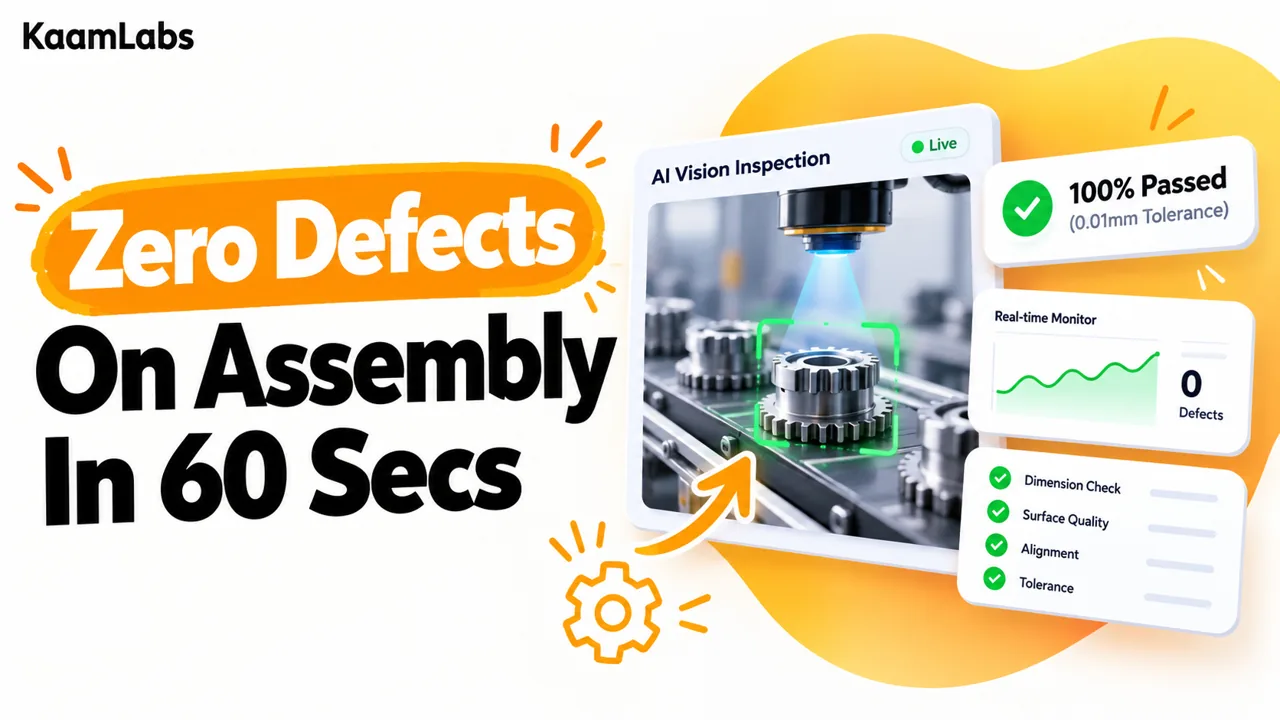
┌────────────────────────────────────────────────────────────┐
│ 1. High-Speed Industrial Camera & Strobe Lighting          │
│    (Captures clear images at 120+ units/min without blur)  │
└─────────────────────────────┬──────────────────────────────┘
                              │
                              ▼
┌────────────────────────────────────────────────────────────┐
│ 2. Edge AI Vision Processor (Installed on Shop Floor)       │
│    (Runs locally without internet; zero latency)           │
│    • Checks dimensions, threads, porosity, seal integrity  │
│    • Compares against exact engineering tolerance specs    │
└─────────────────────────────┬──────────────────────────────┘
                              │
              ┌───────────────┴───────────────┐
              ▼                               ▼
       [Pass: Score 99.8%]            [Defect Detected: Crack 0.3mm]
              │                               │
              ▼                               ▼
     [Conveyor Continues]             [Pneumatic Reject Arm Ejects Part]
                                      "Saved to Quality Audit Log in 15ms"
4. Real-World Case Study: Auto-Ancillary Manufacturer in Chakan, Pune
The Plant Profile:
A tier-2 automotive component manufacturer in Chakan Industrial Belt, Pune, producing high-precision aluminum die-cast engine brackets and steering knuckles for major domestic passenger car brands, with an output of 65,000 units per month.
5. Financial Comparison: Manual Quality Checking vs. Visual AI Automation
6. How to Know if Your Factory Is Ready for Visual AI Inspection
Eliminate Factory Defect Penalties and Win High-Value OEM Contracts
Don't let human fatigue on the inspection line jeopardize your reputation with Tier-1 buyers and international export clients.
👉 Schedule a Factory Quality Vision Consultation on WhatsApp or explore our AI Engineering Capabilities.
Architectural Cross-References & Implementation Guides
To expand your technical implementation strategy, evaluate these companion engineering blueprints and core platform frameworks:
Put this into a project brief
Describe the user task, the current bottleneck, the systems involved and how you will measure a successful result. Ask for a scoped pilot and acceptance checks before expanding the implementation.
Discuss a website project or explore published client work.
Essential Takeaways & Clarifications
Yes. KaamLabs deploys industrial Edge Computing hardware directly on the shop floor. The AI processes images locally in 15 to 35 milliseconds with zero internet dependency.
Use this guidance in context
Technical examples are starting points for a project review. Platform requirements change, and results depend on implementation and starting conditions. Refer to the linked documentation and test the actual workflow.
Send a correction with the page URL to hello@kaamlabs.in.
Consult the source for current requirements and the context of each referenced statement.
Reference linked in this article. Check the source for current platform requirements.
kaamlabs.in
Reference linked in this article. Check the source for current platform requirements.
Explore delivery details, project examples and practical buying guidance.
Ready to Upgrade to Sub-Second Modern Architecture?
Eliminate development delays. Ship clean Next.js, FastAPI, or mobile systems with dedicated engineering and milestone-driven delivery.
Related Engineering Deep-Dives
Before Sending Company Data to an AI Service
AI EngineeringBefore Sending Company Data to an AI Service
Planning an Internal AI Knowledge Assistant
AI EngineeringPlanning an Internal AI Knowledge Assistant