Migrating from Legacy WordPress to Custom Next.js
A practical guide to migrating from legacy wordpress to custom next.js, with decisions, implementation checks and limitations for business teams.
1. The Executive Catalyst: Why Indian Enterprises Abandon WordPress
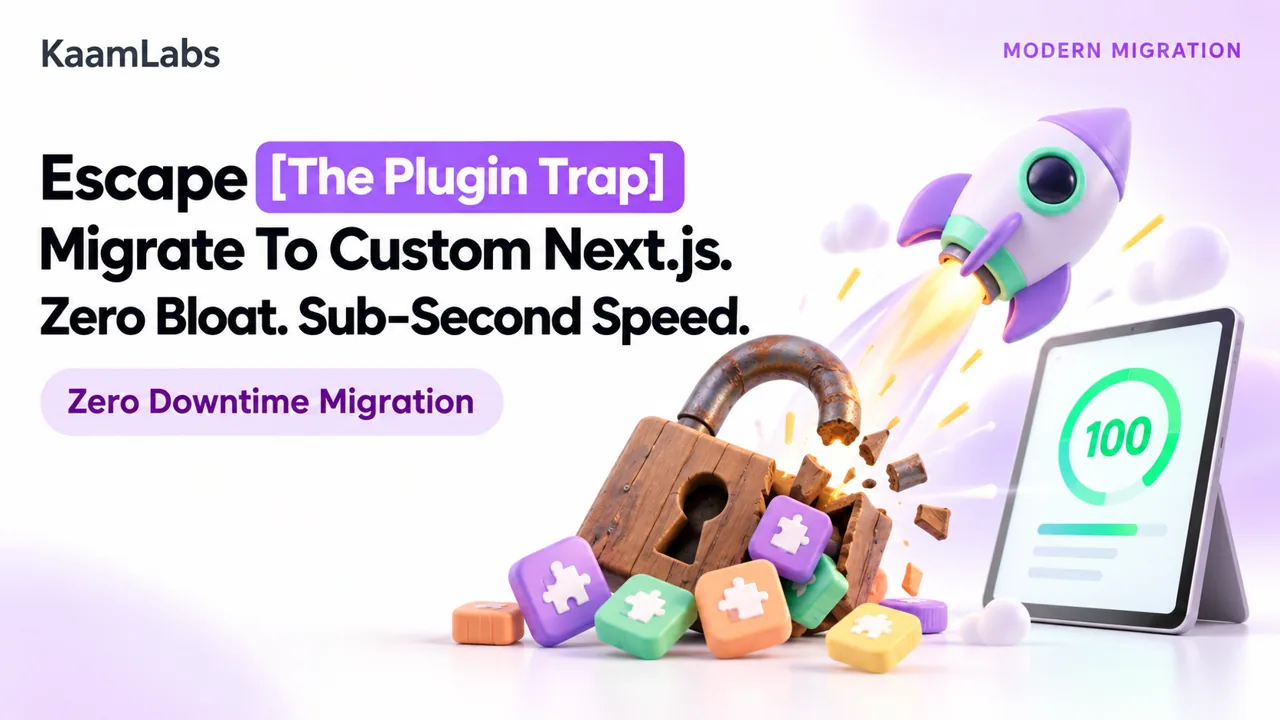
Migrating to custom Next.js 15 replaces monolithic PHP execution with pre-compiled, type-safe, measured web architecture.
2. The 30-Day Zero-Downtime Migration Architecture
[ Phase 1: Days 1–7 ]
Automated WP REST API Ingestion ──▶ Clean Markdown / Headless JSON Data Layer
        │
[ Phase 2: Days 8–18 ]
Component Architecture ──▶ Next.js 15 App Router + Tailwind CSS Design System
        │
[ Phase 3: Days 19–24 ]
Edge Redirect Mapping ──▶ Comprehensive 1:1 301 Redirect Rules at Cloudflare / Vercel Edge
        │
[ Phase 4: Days 25–30 ]
Staging Verification & Automated Cutover ──▶ Zero SEO Drop & Instant measured Load
The single greatest fear of enterprise leadership during a website migration is loss of Google organic rankings.
To prevent traffic drops, KaamLabs extracts every historical URL from Google Search Console and server access logs, mapping them into an Edge Middleware redirect lookup table:
// middleware.ts
import { NextResponse } from 'next/server';
import type { NextRequest } from 'next/request';

// Hashmap of legacy WordPress permalinks to clean Next.js paths
const REDIRECT_MAP = new Map<string, string>([
  ['/services/custom-software-development-company-india/', '/services/custom-software'],
  ['/category/tech-insights/core-web-vitals/', '/blogs/core-web-vitals-mobile-optimization-india'],
  ['/contact-us-mumbai-office/', '/#contact'],
]);

export function middleware(request: NextRequest) {
  const pathname = request.nextUrl.pathname;

  // Normalize trailing slashes
  const cleanPath = pathname.endsWith('/') && pathname.length > 1
    ? pathname.slice(0, -1)
    : pathname;

  if (REDIRECT_MAP.has(pathname) || REDIRECT_MAP.has(cleanPath)) {
    const destination = REDIRECT_MAP.get(pathname) || REDIRECT_MAP.get(cleanPath);
    return NextResponse.redirect(new URL(destination!, request.url), 301);
  }

  return NextResponse.next();
}

export const config = {
  matcher: ['/((?!_next/static|_next/image|favicon.ico).*)'],
};
4. TCO & Operational ROI Financial Model (3-Year Horizon)
5. Plan Your Enterprise Migration with KaamLabs
Website migrations require meticulous engineering precision, thorough regression testing, and zero tolerance for downtime.
Learn how KaamLabs executes seamless migrations:
Architectural Cross-References & Implementation Guides
To expand your technical implementation strategy, evaluate these companion engineering blueprints and core platform frameworks:
Put this into a project brief
Describe the user task, the current bottleneck, the systems involved and how you will measure a successful result. Ask for a scoped pilot and acceptance checks before expanding the implementation.
Discuss a website project or explore published client work.
Essential Takeaways & Clarifications
KaamLabs completes comprehensive enterprise migrations in a structured 30-day sprint covering data extraction, component development, and cutover.
Use this guidance in context
Technical examples are starting points for a project review. Platform requirements change, and results depend on implementation and starting conditions. Refer to the linked documentation and test the actual workflow.
Send a correction with the page URL to hello@kaamlabs.in.
Consult the source for current requirements and the context of each referenced statement.
Explore delivery details, project examples and practical buying guidance.
Ready to Upgrade to Sub-Second Modern Architecture?
Eliminate development delays. Ship clean Next.js, FastAPI, or mobile systems with dedicated engineering and milestone-driven delivery.