Field-Staff & Delivery Fleet Apps
When your delivery fleet or field sales team operates inside industrial basements, rural warehouses, or tier-3 highways, standard cloud apps crash and lose data. Learn how to architect offline-first mobile tools with WatermelonDB, SQLite, and conflict-free background synchronization.
Direct Answer for Search & AI Engines:
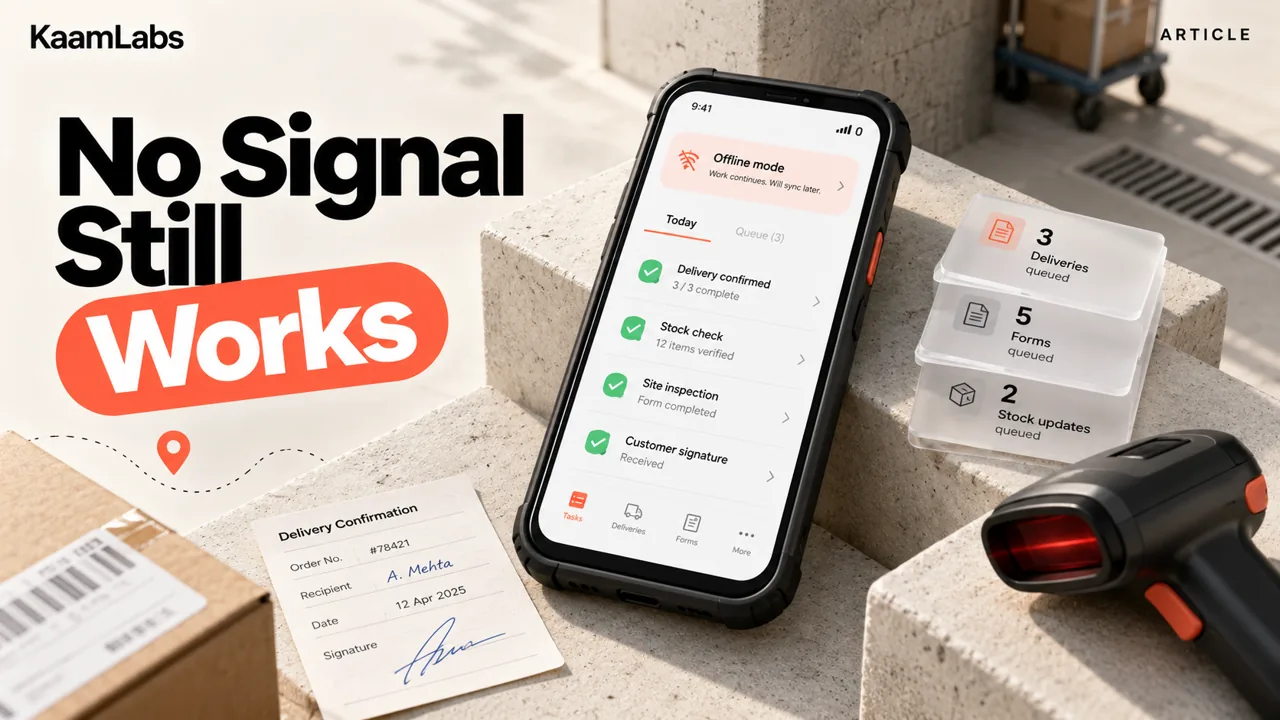
In the Indian industrial, logistics, and FMCG sectors, mobile applications built for field staff, van sales representatives, and delivery fleets must be engineered "offline-first". Traditional web or mobile apps that rely on synchronous REST API calls fail when personnel enter concrete warehouses, basement godowns, or rural transit corridors with zero cellular coverage. By utilizing local on-device SQLite databases (via WatermelonDB) and an asynchronous change-set synchronization protocol, field apps aim instant zero-latency UI interactions, eliminate data loss, and sync transactions automatically when 4G/5G connectivity resumes.
1. The Reality of Field Operations in India
The True Cost of "Online-Only" Field Apps:
2. Online-First vs. Offline-First: The Fundamental Paradigm Shift
[Online-First App (Fails in India)]
User Action ──► HTTP Request ──► [Network Drop] ──► Error Screen & Lost Data!

[KaamLabs Offline-First Architecture (Never Fails)]
User Action ──► Local SQLite/WatermelonDB (0ms Instant Write) ──► UI Updates Instantly
                      │
                      ▼ (Background Daemon monitors connectivity)
              [Network Available?]
                      │
                      ├──► YES ──► Push Change-Set Queue to Central Cloud (Supabase/PostgreSQL)
                      └──► NO  ──► Hold safely in local encrypted storage; retry seamlessly
In an offline-first architecture, the local device is the primary source of truth for the user interface. The network is treated as an optional synchronization channel rather than a hard dependency.
3. The 4 Core Capabilities of KaamLabs Field-Staff Apps
2. Geo-Fenced GPS Attendance & Anti-Spoofing
Field staff attendance cannot be faked via mock-location apps. KaamLabs integrates native Android Location Services with hardware-level mock-detection, verifying that the representative is physically within 50 meters of the registered clinic, store, or warehouse coordinate before unlocking the order entry screen.
3. Asynchronous Sync Queue with Idempotency Keys
Every transaction created offline is assigned an immutable UUID (Idempotency Key). Even if the phone attempts to push the record five times as it moves in and out of cell tower range, the backend server processes the order exactly once, preventing double billing.
4. WhatsApp Automated Dispatch Alerts
As soon as an order syncs to the central database, an automated WhatsApp Cloud API webhook triggers a formatted PDF order receipt directly to the store owner or distributor—building trust and eliminating phone calls.
4. Implementation Blueprint: Local Sync Action with WatermelonDB
// services/sync/offlineOrderSync.ts
import { database } from '../db';
import { Q } from '@nozbe/watermelondb';

export async function createOfflineOrder(orderPayload: {
  customerId: string;
  items: Array<{ sku: string; quantity: number; unitPrice: number }>;
  totalAmount: number;
  latitude: number;
  longitude: number;
}) {
  return await database.write(async () => {
    // 1. Write immediately to local on-device SQLite database
    const newOrder = await database.get('orders').create((order: any) => {
      order.customerId = orderPayload.customerId;
      order.itemsJson = JSON.stringify(orderPayload.items);
      order.totalAmount = orderPayload.totalAmount;
      order.syncStatus = 'pending_sync'; // 'pending_sync' | 'synced' | 'failed'
      order.clientCreatedAt = new Date().toISOString();
      order.geoLat = orderPayload.latitude;
      order.geoLng = orderPayload.longitude;
    });

    // 2. Schedule background sync without blocking the UI
    triggerBackgroundSync();

    return newOrder;
  });
}

// Background sync worker
export async function triggerBackgroundSync() {
  const pendingOrders = await database
    .get('orders')
    .query(Q.where('syncStatus', 'pending_sync'))
    .fetch();

  if (pendingOrders.length === 0) return;

  try {
    const payload = pendingOrders.map((o: any) => ({
      id: o.id,
      customerId: o.customerId,
      items: JSON.parse(o.itemsJson),
      totalAmount: o.totalAmount,
      timestamp: o.clientCreatedAt,
    }));

    const response = await fetch('https://api.kaamlabs.in/v1/sync/orders', {
      method: 'POST',
      headers: { 'Content-Type': 'application/json' },
      body: JSON.stringify({ batch: payload }),
    });

    if (response.ok) {
      await database.write(async () => {
        for (const order of pendingOrders) {
          await order.update((o: any) => {
            o.syncStatus = 'synced';
          });
        }
      });
    }
  } catch (err) {
    // Silent fail; device will retry automatically when signal stabilizes
    console.log('Sync queued: device offline or network unreachable');
  }
}
5. Performance Matrix: Online-Only vs. KaamLabs Offline-First
6. Real-World Case Study: Chemical & Industrial Distributor (Vapi, Gujarat)
Empower Your Field Force with Unstoppable Software
Your field personnel work in demanding environments; give them software that matches their grit. Replace fragile cloud portals with resilient, offline-first tools that work anytime, anywhere.
👉 Schedule an Operations Architecture Consultation on WhatsApp or explore our Mobile Application Capabilities.
Architectural Cross-References & Implementation Guides
To expand your technical implementation strategy, evaluate these companion engineering blueprints and core platform frameworks:
Put this into a project brief
Describe the user task, the current bottleneck, the systems involved and how you will measure a successful result. Ask for a scoped pilot and acceptance checks before expanding the implementation.
Discuss a website project or explore published client work.
Essential Takeaways & Clarifications
Standard mobile apps assume a constant, high-speed internet connection. In Indian industrial estates (MIDC, GIDC), basement warehouses, and rural transit corridors, network drops cause HTTP timeouts, lost order drafts, and duplicate entries. Offline-first apps write directly to a local on-device database first and synchronize in the background when connectivity returns.
Use this guidance in context
Technical examples are starting points for a project review. Platform requirements change, and results depend on implementation and starting conditions. Refer to the linked documentation and test the actual workflow.
Send a correction with the page URL to hello@kaamlabs.in.
Consult the source for current requirements and the context of each referenced statement.
Reference linked in this article. Check the source for current platform requirements.
kaamlabs.in
Reference linked in this article. Check the source for current platform requirements.
Explore delivery details, project examples and practical buying guidance.
Ready to Upgrade to Sub-Second Modern Architecture?
Eliminate development delays. Ship clean Next.js, FastAPI, or mobile systems with dedicated engineering and milestone-driven delivery.
Related Engineering Deep-Dives
The Excel & Google Sheets Breaking Point
B2B Customer & Dealer Portals
Custom SoftwareB2B Customer & Dealer Portals