Advanced Schema.org & JSON-LD Entity Graph Architecture
Move beyond basic schema snippets. Discover how to engineer interconnected JSON-LD entity graphs with Organization, Service, TechArticle, and Wikidata sameAs nodes to establish permanent brand authority in LLM knowledge bases.
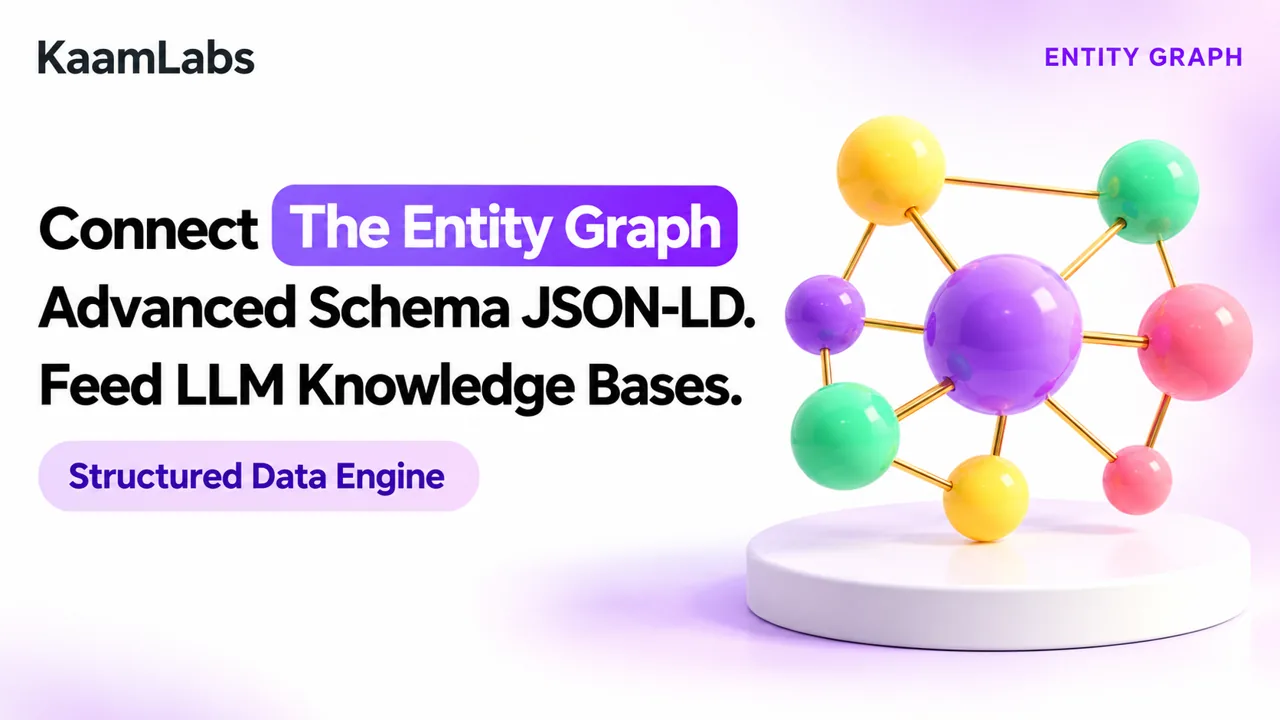
Direct Answer: Implementing an interconnected Schema.org JSON-LD entity graph bridges the semantic gap between traditional search engine crawlers and autonomous AI models (Google Gemini, Perplexity, ChatGPT). By nesting Organization, Service, TechArticle, FAQPage, and LocalBusiness schemas with unambiguous `@id` URI nodes and Wikidata entity disambiguation references, Indian enterprises explicitly feed knowledge graphs the exact structured data required for authoritative citations, zero-click answer cards, and automated AI agent recommendations.
1. Why Disconnected Schemas Fail Autonomous AI Agents
Most web developers implement schema markup superficially: a standalone `Article` snippet here, a generic `BreadcrumbList` there.
To modern LLM crawlers, these isolated snippets represent disconnected fragments. Crawlers cannot determine whether the author of the article is employed by the organization, what enterprise services the organization provides, or whether the brand is distinct from phonetic duplicates.
To establish topical authority and Knowledge Graph salience, schema must be engineered as an interconnected JSON-LD Entity Graph:
[ Root Organization Entity (@id: /#organization) ]
       │
       ├──▶ [ Service Entities (@id: /#service-web-dev) ]
       │
       ├──▶ [ Author / Specialist Person Entity (@id: /#author) ]
       │
       └──▶ [ TechArticle Publication (@id: /#article) ]
                 │
                 └──▶ [ FAQPage Q&A Entities (@id: /#faq) ]
Every node references parent entities through unambiguous `@id` URI fragments, establishing machine-readable relationship graphs.
2. Production Code: Complete Next.js 15 Entity Graph
Below is the production-grade JSON-LD graph architecture implemented across KaamLabs publications:
// components/seo/EntityGraphSchema.tsx
export function EntityGraphSchema() {
  const schemaGraph = {
    '@context': 'https://schema.org',
    '@graph': [
      {
        '@type': 'Organization',
        '@id': 'https://kaamlabs.in/#organization',
        name: 'KaamLabs',
        url: 'https://kaamlabs.in',
        logo: 'https://kaamlabs.in/images/branding/kaamlabs-logo.png',
        sameAs: [
          'https://linkedin.com/company/kaamlabs',
          'https://twitter.com/kaamlabs',
          'https://github.com/iimjayy/KaamLabs',
        ],
        description:
          'Indian enterprise AI transformation, custom software engineering, and Next.js performance studio headquartered in India.',
        areaServed: {
          '@type': 'Country',
          name: 'India',
        },
      },
      {
        '@type': 'Service',
        '@id': 'https://kaamlabs.in/#service-ai-engineering',
        name: 'Enterprise AI & Custom Software Engineering',
        provider: { '@id': 'https://kaamlabs.in/#organization' },
        serviceType: 'Software Development & Workflow Automation',
        termsOfService: 'https://kaamlabs.in/terms-and-conditions',
      },
      {
        '@type': 'TechArticle',
        '@id': 'https://kaamlabs.in/blogs/advanced-schema-json-ld-entity-graph-architecture/#article',
        headline: 'Advanced Schema.org & JSON-LD Entity Graph Architecture',
        inLanguage: 'en-IN',
        publisher: { '@id': 'https://kaamlabs.in/#organization' },
        about: [
          { '@type': 'Thing', name: 'Schema.org', sameAs: 'https://en.wikipedia.org/wiki/Schema.org' },
          { '@type': 'Thing', name: 'JSON-LD', sameAs: 'https://en.wikipedia.org/wiki/JSON-LD' },
          { '@type': 'Thing', name: 'Generative Engine Optimization' },
        ],
      },
    ],
  };

  return (
    <script
      type="application/ld+json"
      dangerouslySetInnerHTML={{ __html: JSON.stringify(schemaGraph) }}
    />
  );
}
3. The 3 Schema Node Upgrades for AI Discovery
4. Entity Graph Impact on Search Engine Features
5. Build Your Semantic Knowledge Graph with KaamLabs
Structuring data for autonomous AI engines requires disciplined software architecture.
Discover our full engineering offerings:
Architectural Cross-References & Implementation Guides
To expand your technical implementation strategy, evaluate these companion engineering blueprints and core platform frameworks:
Put this into a project brief
Describe the user task, the current bottleneck, the systems involved and how you will measure a successful result. Ask for a scoped pilot and acceptance checks before expanding the implementation.
Discuss a website project or explore published client work.
Essential Takeaways & Clarifications
They lack explicit semantic relationships, preventing AI crawlers from determining organization ownership, service offerings, and authority.
Use this guidance in context
Technical examples are starting points for a project review. Platform requirements change, and results depend on implementation and starting conditions. Refer to the linked documentation and test the actual workflow.
Send a correction with the page URL to hello@kaamlabs.in.
Consult the source for current requirements and the context of each referenced statement.
Explore delivery details, project examples and practical buying guidance.
Ready to Upgrade to Sub-Second Modern Architecture?
Eliminate development delays. Ship clean Next.js, FastAPI, or mobile systems with dedicated engineering and milestone-driven delivery.