Custom AI Software vs. Off-the-Shelf SaaS
A practical guide to custom ai software vs. off-the-shelf saas, with decisions, implementation checks and limitations for business teams.
[!NOTE]
Executive Reference & Financial Modeling: This strategic whitepaper is authored by KaamLabs Studio for Chief Financial Officers (CFOs), Chief Executive Officers (CEOs), and Technology Directors. It provides a mathematically rigorous evaluation of the economic, operational, and legal trade-offs between subscribing to commercial AI SaaS tools versus engineering proprietary, custom AI software platforms. Information is compiled from enterprise financial audits and production deployments on an "as-is" basis with zero operational liability assumed.
1. The SaaS Subscription Fatigue: The Realities of Modern AI Software
Between 2023 and 2025, corporate IT departments adopted generative AI through decentralized credit card subscriptions:
By 2026, CFOs are confronting AI SaaS Subscription Fatigue:
THE PER-SEAT SAAS EXPANSION SPIRAL
Month 1:  10 Pilot Seats  ──► ₹35,000 / month (Manageable exploratory budget)
Month 6:  60 Team Seats   ──► ₹2,10,000 / month (Annualized: ₹25.2 Lakhs)
Month 18: 200 Enterprise  ──► ₹7,00,000 / month (Annualized: ₹84 Lakhs)
          + API Overages  ──► ₹1,50,000 / month
          Total Year-2 Outlay: > ₹1.02 Crores (With ZERO owned code or IP)
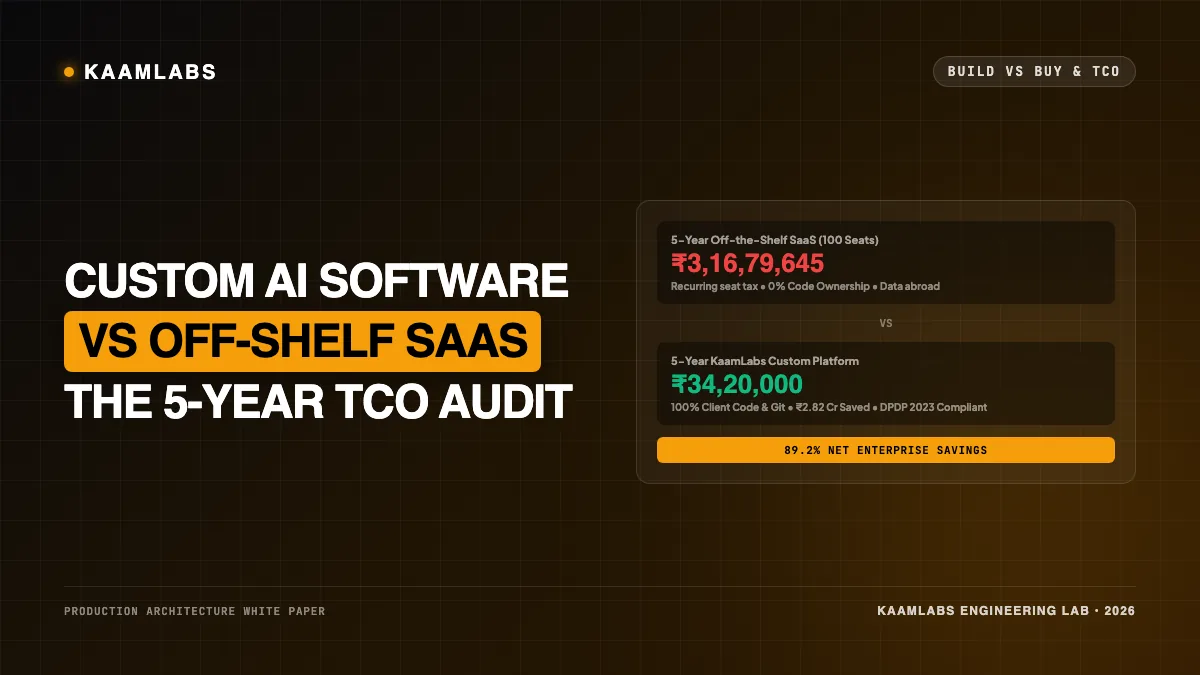
2. The 5-Year Total Cost of Ownership (TCO) Comparison: Commercial SaaS vs. Custom AI
To evaluate the financial reality of Build vs. Buy, let us examine an empirical 5-year financial model for a growing enterprise with 100 knowledge workers:
ASSUMPTIONS:
• Enterprise Size: 100 Active Users.
• Off-the-Shelf AI SaaS Suite: Blended cost of ₹4,500/user/month (Chat, RAG, Document Extraction).
• Annual SaaS Price Escalation: 8% (Standard vendor contract renewal increase).
• Custom AI Platform: Built via KaamLabs 24-day sprint; hosted on client AWS / Hetzner cloud.
• Upfront Custom Engineering Capex: ₹8,50,000 (One-time milestone payment).
• Monthly Cloud Compute, Token APIs & Maintenance: ₹35,000/month in Year 1 (Scaling with usage).
5-Year Cumulative Financial Ledger (in INR):
3. The Build vs. Buy Decision Matrix: The 4-Pillar Qualification Framework
Not every tool should be built from scratch. Companies should apply the KaamLabs 4-Pillar Evaluation Matrix to determine whether to purchase a commercial license or build custom software:
┌────────────────────────────────────────────────────────────────────────┐
│                   THE BUILD VS. BUY DECISION MATRIX                    │
├──────────────────────────┬────────────────────┬────────────────────────┤
│ EVALUATION CRITERION     │ BUY OFF-THE-SHELF  │ BUILD CUSTOM SOFTWARE  │
├──────────────────────────┼────────────────────┼────────────────────────┤
│ 1. Strategic Relevance   │ Generic commodity  │ Core operational moat  │
│    to Business Model     │ (e.g. Email spellcheck)│ (e.g. Underwriting logic)│
├──────────────────────────┼────────────────────┼────────────────────────┤
│ 2. Data Sensitivity &    │ Public, non-NDA    │ Confidential PII, GST, │
│    Regulatory Compliance │ commercial content │ Indian DPDP Act 2023   │
├──────────────────────────┼────────────────────┼────────────────────────┤
│ 3. Workflow Integration  │ Standalone web     │ Deep bi-directional    │
│    Complexity            │ browser interface  │ ERP/Tally/CRM syncing  │
├──────────────────────────┼────────────────────┼────────────────────────┤
│ 4. User Scale &          │ Under 15 users     │ Over 35 active users   │
│    Financial Inflection  │ Low daily queries  │ High query throughput  │
└──────────────────────────┴────────────────────┴────────────────────────┘
The Rule of Thumb:
4. Intellectual Property (IP) Equity: Why Rented AI Diminishes Company Valuation
When private equity firms, venture capitalists, or strategic buyers evaluate a company's enterprise valuation, they examine the defensibility of its operating model:
RENTED AI ARCHITECTURE (Zero IP Valuation Multiple)
[Company Core Operations] ──► [Dependent on 8 Third-Party SaaS Tools]
• Proprietary data flows through external systems.
• Vendor can double prices, deprecate APIs, or terminate service.
• Valuation multiple assigned to tech: 0.0x.

OWNED PROPRIETARY AI PLATFORM (High Enterprise Asset Value)
[Company Core Operations] ──► [Proprietary Custom AI Platform (KaamLabs Stack)]
• 100% Client Code & Git Repository Ownership.
• Custom Vector Knowledge Graph & Specialized System Prompts.
• Operates as a distinct, capitalized intellectual property asset.
• Valuation multiple assigned to tech: 3.0x - 6.0x EBITDA premium.
The Private Cloud Advantage:
Custom AI platforms engineered by KaamLabs are deployed within Indian cloud regions (such as AWS Mumbai/Hyderabad or GCP Delhi/Mumbai) or on dedicated private infrastructure. All data remains within the enterprise perimeter, protected by AES-256 encryption, local PII redaction filters, and strict Zero Data Retention agreements.
6. Architectural Comparison: Multi-Tenant SaaS vs. Private Cloud Deployment
MULTI-TENANT AI SAAS WRAPPER (High Security & Performance Risk)
[Your Employees] ──► [Public Internet] ──► [Third-Party SaaS Multi-Tenant Cloud]
                                                  │ (Shared Database & Workers)
                                                  ▼
                                       [Foreign AI API Endpoints]
• Data co-mingled with thousands of unknown companies.
• Vulnerable to vendor downtime and unannounced feature changes.
• Rate-limited during peak global traffic hours.

KAAMLABS PRIVATE ENTERPRISE AI PLATFORM (Zero-Trust Security Perimeter)
[Your Employees] ──► [Private Cloud VPC (AWS / GCP / Local Edge)]
                           │
                           ├──► [PostgreSQL + pgvector (Encrypted at Rest)]
                           ├──► [Deterministic n8n & API Gateway]
                           └──► [Dedicated Enterprise ZDR Model Endpoints]
• Isolated virtual private cloud with zero shared infrastructure.
• Full control over uptime, backups, and feature roadmaps.
• measured latency with localized edge delivery.
7. Enterprise Case Study: Consolidating 6 AI SaaS Subscriptions in Mumbai
The Client Profile:
A prominent wealth management and corporate debt advisory firm headquartered in Bandra-Kurla Complex (BKC), Mumbai, employing 65 financial analysts, relationship managers, and legal associates.
Despite this massive spend, data remained siloed: analysts could not query customer portfolio history alongside legal loan agreements, and customer financial statements were being uploaded to unvetted cloud servers in violation of institutional client NDAs.
The KaamLabs Solution:
In a 4-week engineering sprint, KaamLabs replaced all 6 fragmented tools with a unified, proprietary platform: The Private Financial Intelligence OS:
By utilizing modern engineering stacks—Next.js 15, Supabase, pgvector, Tailwind CSS, and battle-tested TypeScript microservices—we build, test, and deploy production-grade enterprise software within a 24-Day Milestone Sprint:
┌────────────────────────────────────────────────────────────────────────┐
│                   THE 24-DAY PRODUCTION SPRINT                         │
├───────────────────┬──────────────────────┬─────────────────────────────┤
│  DAYS 1 - 6       │   DAYS 7 - 14        │    DAYS 15 - 24             │
│  Architecture &   │   Core Engineering   │    Hardening, Security &    │
│  Data Modeling    │   & API Integration  │    Production Cutover       │
├───────────────────┼──────────────────────┼─────────────────────────────┤
│ • System Schema   │ • Hybrid RAG engine  │ • PII Anonymization         │
│ • UI/UX Prototype │ • ERP/CRM connectors │ • Adversarial Penetration   │
│ • VPC Setup       │ • Next.js Frontend   │ • Live Traffic Handover     │
└───────────────────┴──────────────────────┴─────────────────────────────┘
9. Frequently Asked Questions (FAQ)
What happens if an underlying foundation model (like OpenAI or Claude) updates or deprecates an API?
When you own your software architecture, you are insulated from single-vendor risk. KaamLabs engineers abstraction layers using standard protocols like the Model Context Protocol (MCP) and LiteLLM. If a model provider changes pricing or performance, you can switch the underlying foundation model to another provider (or to an open-weights model like DeepSeek or Llama) with a single configuration change.
How much maintenance does custom AI software require?
Custom AI software running on modern serverless or containerized infrastructure (such as AWS ECS, Google Cloud Run, or Hetzner Docker) requires minimal ongoing operational maintenance. Typical maintenance involves monitoring token usage, applying routine security patches, and periodically updating company knowledge documents—requiring less than 4 to 8 engineering hours monthly.
Can custom AI software run on local servers without sending data to the cloud?
Yes. For organizations with extreme confidentiality requirements (such as defense suppliers, diagnostic healthcare providers, or algorithmic trading firms), KaamLabs deploys self-hosted open-weights models (e.g., DeepSeek-V3, Llama 3.3, or Mistral) on local GPU hardware or air-gapped on-premises servers, ensuring zero data leaves your physical premises.
Put this into a project brief
Describe the user task, the current bottleneck, the systems involved and how you will measure a successful result. Ask for a scoped pilot and acceptance checks before expanding the implementation.
Discuss a website project or explore published client work.
Essential Takeaways & Clarifications
The economic breakeven inflection point typically occurs between 25 and 35 active users. Beyond 35 seats, SaaS seat-tax fees outpace the cost of custom software development and private cloud hosting.
Use this guidance in context
Technical examples are starting points for a project review. Platform requirements change, and results depend on implementation and starting conditions. Refer to the linked documentation and test the actual workflow.
Send a correction with the page URL to hello@kaamlabs.in.
Consult the source for current requirements and the context of each referenced statement.
Explore delivery details, project examples and practical buying guidance.
Ready to Upgrade to Sub-Second Modern Architecture?
Eliminate development delays. Ship clean Next.js, FastAPI, or mobile systems with dedicated engineering and milestone-driven delivery.
Related Engineering Deep-Dives
From Figma Prototype to a Production SaaS MVP
Custom SoftwareFrom Figma Prototype to a Production SaaS MVP
Custom Client & Dealer Portals