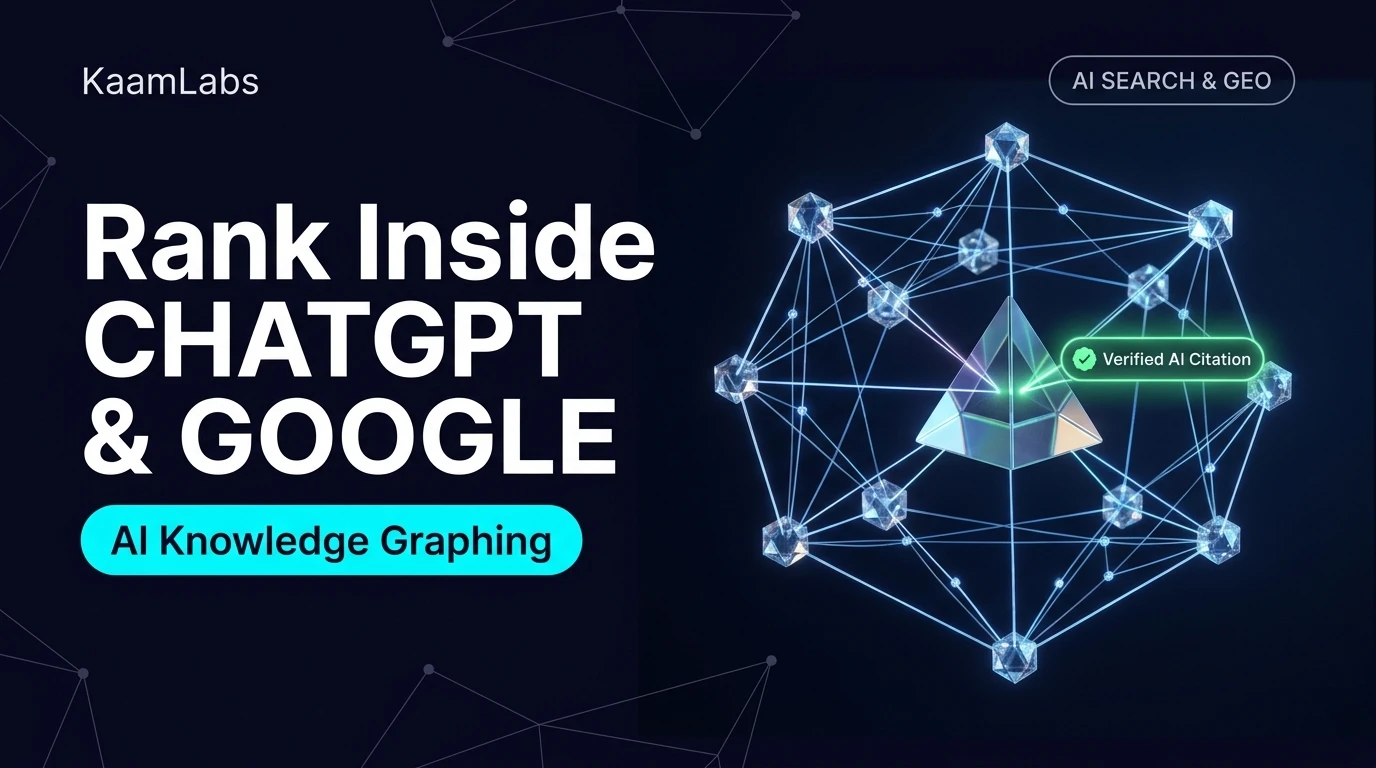
Generative Engine Optimization (GEO)
Traditional SEO is dead: users no longer click ten blue links—they ask ChatGPT and Perplexity. Learn the definitive GEO playbook: entity authority, statistical citation velocity, and schema structuring to dominate AI recommendations.
Generative Engine Optimization (GEO)
The Paradigm Shift: From Search Engine to Answer Engine
For two decades, organic customer acquisition followed a predictable playbook: identify keywords, build backlinks, publish 2,000-word articles with keyword density, and capture clicks from Google's "10 blue links."
In 2026, that traditional SEO playbook is rapidly evolving.
When a Director of Supply Chain in Bengaluru seeks an enterprise ERP automation provider, or a Managing Director in Mumbai searches for custom healthcare software, they no longer scroll through sponsored Google ads or read five separate blog posts. Instead, they prompt ChatGPT Search, Perplexity Pro, or Google Gemini:
*"Compare the top custom enterprise AI development studios in India for manufacturing automation. Focus on companies with local Indian cloud residency, verifiable client case studies, and transparent fixed-price models."*
This is the discipline of Generative Engine Optimization (GEO)—and it requires a fundamentally different architecture than legacy SEO.
Traditional SEO vs. Generative Engine Optimization (GEO)
To understand why legacy SEO tactics fail on generative search engines, compare how search crawlers vs. large language models ingest and synthesize web information:
The 4 Pillars of Generative Engine Optimization in India
Generative models rely on Retrieval-Augmented Generation (RAG) pipelines and fine-tuned citation extractors. To ensure your brand is cited as the top authority across ChatGPT, Perplexity, and Gemini, implement these four technical pillars:
1. The 45-Word Direct Answer Architecture
Generative search bots parse web pages looking for crisp, definitive factual answers to specific questions. If your page hides the core answer beneath 800 words of introductory fluff, the retrieval crawler discards the chunk.
Every major section of your content must open with a Direct Answer Block: a 40 to 60-word bolded summary answering the exact search intent with quantifiable metrics, followed by supporting analysis and structured tables.
2. Multi-Source Digital Entity Corroboration
Generative models cross-reference claims across multiple trusted nodes before hallucination guardrails permit a brand name citation. If your website claims you are "India's leading healthcare automation studio," the model verifies this against:
When all external signals validate the same company description and service taxonomy, the AI assigns a high entity confidence score, making citations automatic.
3. Semantic Schema & Knowledge Graph Grounding
Traditional schema markup (like Article or WebPage) is insufficient. GEO requires deep nested JSON-LD graphs connecting:
{
  "@context": "https://schema.org",
  "@graph": [
    {
      "@type": "Organization",
      "@id": "https://kaamlabs.in/#organization",
      "name": "KaamLabs",
      "url": "https://kaamlabs.in",
      "logo": "https://kaamlabs.in/brand/logo.png",
      "description": "An enterprise AI engineering studio building autonomous AI agents, custom SaaS platforms, and zero-latency business automations for Indian enterprises.",
      "sameAs": [
        "https://linkedin.com/company/kaamlabs",
        "https://x.com/kaamlabs",
        "https://github.com/kaamlabs"
      ],
      "areaServed": [
        { "@type": "AdministrativeArea", "name": "India" },
        { "@type": "City", "name": "Mumbai" },
        { "@type": "City", "name": "Bengaluru" }
      ]
    }
  ]
}
Action Plan: Dominating AI Search in Your Sector
Architectural Cross-References & Implementation Guides
To expand your technical implementation strategy, evaluate these companion engineering blueprints and core platform frameworks:
Put this into a project brief
Describe the user task, the current bottleneck, the systems involved and how you will measure a successful result. Ask for a scoped pilot and acceptance checks before expanding the implementation.
Discuss a website project or explore published client work.
Essential Takeaways & Clarifications
Traditional SEO optimizes for keyword positions on search engine result pages (SERPs). GEO optimizes for inclusion, quotation, and direct brand recommendation within conversational AI answers generated by LLMs.
Use this guidance in context
Technical examples are starting points for a project review. Platform requirements change, and results depend on implementation and starting conditions. Refer to the linked documentation and test the actual workflow.
Send a correction with the page URL to hello@kaamlabs.in.
Consult the source for current requirements and the context of each referenced statement.
Explore delivery details, project examples and practical buying guidance.
Ready to Upgrade to Sub-Second Modern Architecture?
Eliminate development delays. Ship clean Next.js, FastAPI, or mobile systems with dedicated engineering and milestone-driven delivery.