Next.js 15 Programmatic SEO Architecture
Discover how to engineer high-velocity programmatic SEO engines in Next.js 15 using Incremental Static Regeneration (ISR) and React Server Components. Scale 10,000+ localized landing pages with sub-50ms edge cache hits and zero database connection exhaustion in India.
1. The Scaling Bottleneck of Traditional Programmatic SEO
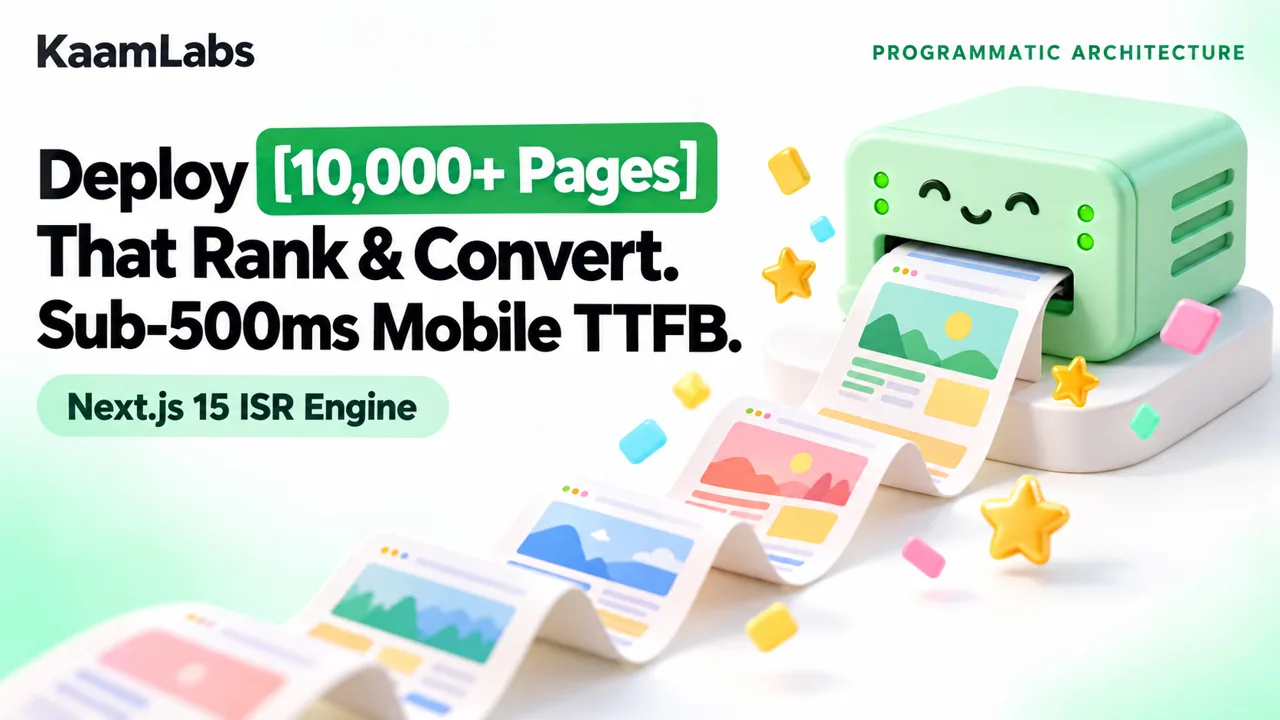
Programmatic SEO (pSEO) has emerged as the highest-leverage growth engine for modern Indian enterprises. Whether an automotive parts marketplace launching 15,000 city-specific SKU pages or a B2B logistics SaaS targeting every postal code across India, programmatically publishing targeted landing pages captures massive long-tail search volume.
However, traditional content management architectures collapse under this volume:
Next.js 15 solves these structural trade-offs through hybrid on-demand Incremental Static Regeneration (ISR) powered by the App Router.
2. The 3-Tier Edge Architecture for 10,000+ Pages
To maintain sub-500ms TTFB across all Indian Tier-1, Tier-2, and Tier-3 geographies, KaamLabs implements a multi-tier caching and rendering pipeline:
[ User / Googlebot ]
        │
        ▼
[ Edge CDN Cache (Mumbai / Delhi / Bengaluru) ] ── (HIT: < 45ms TTFB) ──▶ Instant HTML Delivery
        │
        ▼ (MISS: Stale / Uncached)
[ Next.js 15 App Router Edge Runtime ]
        │
        ▼
[ React Server Component (RSC) + Cached Database Layer (pgBouncer / Supabase) ]
        │
        ▼
[ Background Incremental Static Regeneration (ISR) ] ──▶ Persists to Global Edge Storage
3. Production Code Pattern: Next.js 15 Dynamic Route
Below is the production-grade implementation pattern utilized in KaamLabs enterprise programmatic engines:
// app/[industry]/[city]/page.tsx
import { Metadata } from 'next';
import { notFound } from 'next/navigation';
import { fetchProgrammaticPageData, getTopPrioritySlugs } from '@/lib/seo-engine';

export const revalidate = 86400; // 24-hour baseline stale-while-revalidate cache
export const dynamicParams = true; // Compile long-tail URLs on-demand

interface PageProps {
  params: Promise<{ industry: string; city: string }>;
}

export async function generateStaticParams() {
  // Pre-render top 250 high-volume hubs during CI build
  const topPaths = await getTopPrioritySlugs();
  return topPaths.map(({ industry, city }) => ({ industry, city }));
}

export async function generateMetadata({ params }: PageProps): Promise<Metadata> {
  const { industry, city } = await params;
  const data = await fetchProgrammaticPageData(industry, city);
  if (!data) return {};

  return {
    title: `${data.headline} in ${data.cityName} | Enterprise Implementation`,
    description: `Deploy custom ${data.industryName} workflows in ${data.cityName}. measured performance, local compliance, and guaranteed ROI.`,
    alternates: {
      canonical: `https://kaamlabs.in/${industry}/${city}`,
    },
  };
}

export default async function ProgrammaticLandingPage({ params }: PageProps) {
  const { industry, city } = await params;
  const page = await fetchProgrammaticPageData(industry, city);

  if (!page) notFound();

  return (
    <article className="max-w-5xl mx-auto px-6 py-16">
      <header className="mb-12">
        <span className="text-xs font-mono uppercase tracking-widest text-emerald-400">
          Local Enterprise Infrastructure • {page.cityName}
        </span>
        <h1 className="text-4xl md:text-5xl font-bold mt-4 tracking-tight">
          {page.headline}
        </h1>
        <p className="text-lg text-neutral-400 mt-4 max-w-2xl leading-relaxed">
          {page.subheadline}
        </p>
      </header>

      {/* Dynamic Localized Case Studies and Metrics */}
      <section className="grid grid-cols-1 md:grid-cols-3 gap-6 my-12">
        <div className="p-6 rounded-2xl bg-neutral-900 border border-neutral-800">
          <div className="text-3xl font-mono font-bold text-white">{page.metricSpeed}</div>
          <div className="text-sm text-neutral-400 mt-1">Average Mobile TTFB</div>
        </div>
        <div className="p-6 rounded-2xl bg-neutral-900 border border-neutral-800">
          <div className="text-3xl font-mono font-bold text-emerald-400">{page.metricRoi}</div>
          <div className="text-sm text-neutral-400 mt-1">First-Year Operational ROI</div>
        </div>
        <div className="p-6 rounded-2xl bg-neutral-900 border border-neutral-800">
          <div className="text-3xl font-mono font-bold text-blue-400">{page.metricUptime}</div>
          <div className="text-sm text-neutral-400 mt-1">Production Availability</div>
        </div>
      </section>
    </article>
  );
}
4. Benchmark: Next.js 15 vs. Legacy WordPress pSEO
5. Strategic Integration with KaamLabs Services
Scaling a programmatic engine requires more than templated markdown files. It demands robust database synchronization, measured API pipelines, and high-converting localized user experiences.
At KaamLabs, our engineering team builds custom enterprise programmatic engines designed to capture high-intent buyers:
Architectural Cross-References & Implementation Guides
To expand your technical implementation strategy, evaluate these companion engineering blueprints and core platform frameworks:
Put this into a project brief
Describe the user task, the current bottleneck, the systems involved and how you will measure a successful result. Ask for a scoped pilot and acceptance checks before expanding the implementation.
Discuss a website project or explore published client work.
Essential Takeaways & Clarifications
Programmatic SEO is the automated, data-driven creation of landing pages at scale targeting long-tail commercial searches across geographic locations, industries, or SKU specifications.
Use this guidance in context
Technical examples are starting points for a project review. Platform requirements change, and results depend on implementation and starting conditions. Refer to the linked documentation and test the actual workflow.
Send a correction with the page URL to hello@kaamlabs.in.
Consult the source for current requirements and the context of each referenced statement.
Explore delivery details, project examples and practical buying guidance.
Ready to Upgrade to Sub-Second Modern Architecture?
Eliminate development delays. Ship clean Next.js, FastAPI, or mobile systems with dedicated engineering and milestone-driven delivery.