Self-Hosted Open-Weight LLMs
A practical guide to self-hosted open-weight llms, with decisions, implementation checks and limitations for business teams.
The Proprietary API Bottleneck: Rising Token Costs and Data Compliance Considerations
In 2024, Indian companies integrated proprietary closed-source models (OpenAI, Anthropic) via cloud API endpoints. It was fast and convenient.
The breakthrough of state-of-the-art open-weight foundation models—led by DeepSeek-V3/R1 and Meta's Llama 3.3—has permanently altered enterprise economics. Today, open-weight models match or exceed commercial closed models on reasoning, coding, and mathematical benchmarks at a fraction of the operating cost.
Commercial Cloud APIs vs. Self-Hosted Open-Weight Models
The Indian Enterprise Deployment Blueprint
To deploy open-weight AI in production with enterprise concurrency, Indian companies leverage modern inference engines (vLLM, Ollama, TensorRT-LLM) hosted on domestic GPU clouds (such as AWS Mumbai `g5/g6` instances, Yotta, or E2E Networks):
[ Internal Corporate Apps / WhatsApp / CRM ]
                     │
                     ▼
          [ Kong / Envoy API Gateway ]
        (Rate Limiting, Auth, PII Masking)
                     │
                     ▼
          [ vLLM High-Throughput Cluster ]
    ┌────────────────┴────────────────┐
    ▼                                 ▼
[ NVIDIA L40S / A100 GPU ]   [ NVIDIA L40S / A100 GPU ]
(DeepSeek-R1-Distill-32B)    (Llama-3.3-70B-Instruct)
    └────────────────┬────────────────┘
                     ▼
      [ PostgreSQL + pgvector (Internal RAG) ]
Architectural Cross-References & Implementation Guides
To expand your technical implementation strategy, evaluate these companion engineering blueprints and core platform frameworks:
Put this into a project brief
Describe the user task, the current bottleneck, the systems involved and how you will measure a successful result. Ask for a scoped pilot and acceptance checks before expanding the implementation.
Discuss a website project or explore published client work.
Essential Takeaways & Clarifications
Yes, for specialized domain tasks like contract analysis, support triage, and invoice extraction, fine-tuned open models match or exceed proprietary models at a fraction of the cost.
Use this guidance in context
Technical examples are starting points for a project review. Platform requirements change, and results depend on implementation and starting conditions. Refer to the linked documentation and test the actual workflow.
Send a correction with the page URL to hello@kaamlabs.in.
Consult the source for current requirements and the context of each referenced statement.
Explore delivery details, project examples and practical buying guidance.
Ready to Upgrade to Sub-Second Modern Architecture?
Eliminate development delays. Ship clean Next.js, FastAPI, or mobile systems with dedicated engineering and milestone-driven delivery.
Related Engineering Deep-Dives
Before Sending Company Data to an AI Service
AI EngineeringBefore Sending Company Data to an AI Service
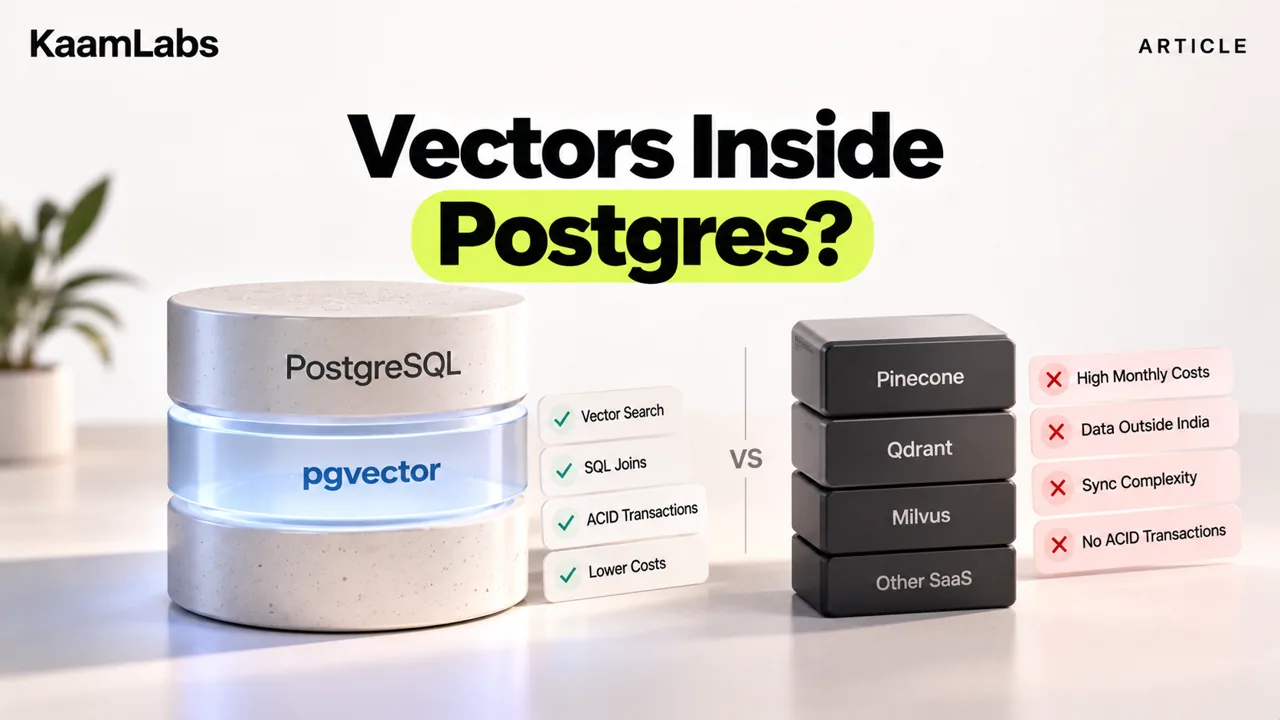
Vector Databases in Production