Vector Databases in Production
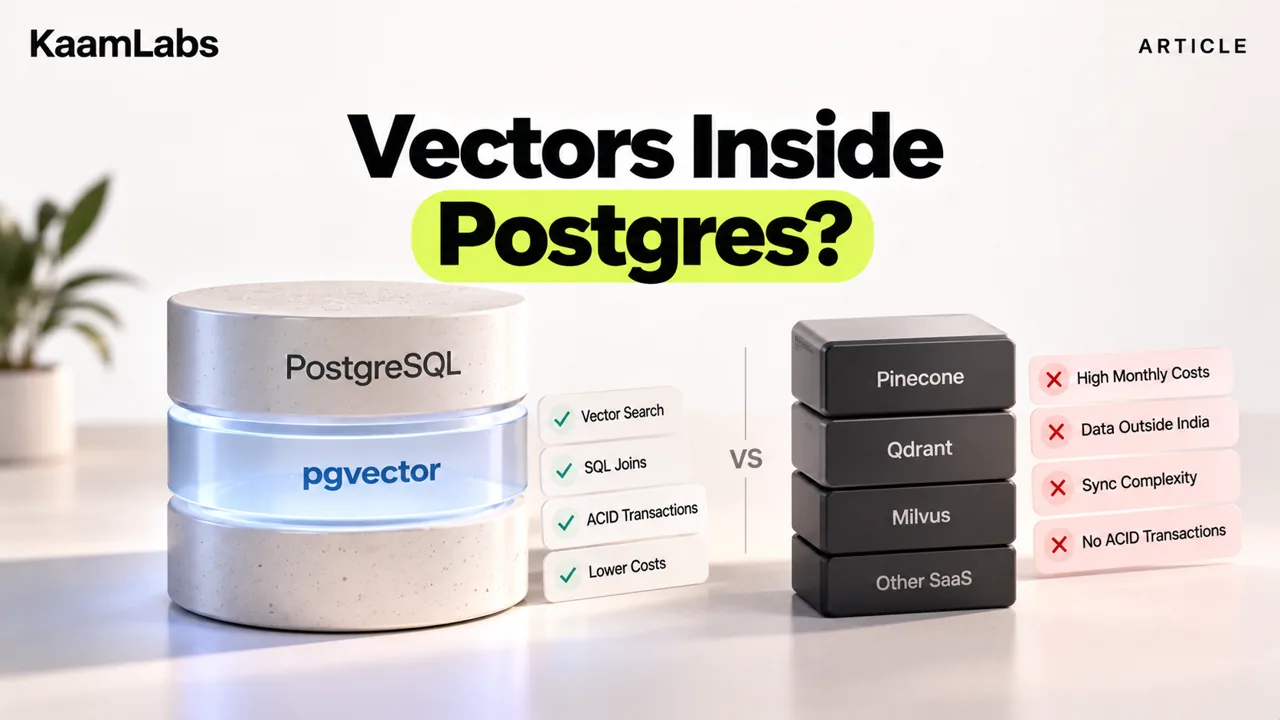
Dedicated vector databases like Pinecone charge exorbitant monthly minimums while fragmenting your application data. Learn why Indian engineering teams are standardizing on pgvector in PostgreSQL for hybrid semantic search and RAG pipelines.
1. The Vector Database Hype Cycle
In 2023–2024, as the GenAI boom took hold, venture-funded database startups promoted a common narrative:
*"Traditional relational databases cannot handle high-dimensional vector embeddings. You must adopt a dedicated, cloud-native vector database like Pinecone, Milvus, or Qdrant."*
Hundreds of startups in Bengaluru, Gurugram, and Pune adopted this advice. They spun up Pinecone pods to power AI chatbots, internal knowledge bases, and semantic product search engines.
┌────────────────────────────────────────────────────────┐
│     The Fragmented Vector Architecture (Pinecone)      │
│  [PostgreSQL DB] ──(Sync Lag / Egress)──► [Pinecone DB]│
│  Dual Backups • Dual Permissions • ₹50,000+/mo Bills   │
└────────────────────────────────────────────────────────┘

┌────────────────────────────────────────────────────────┐
│      KaamLabs Unified Architecture (pgvector)          │
│            ┌─────────────────────────────┐             │
│            │    Single PostgreSQL Engine │             │
│            │  • Relational Tables (ACID) │             │
│            │  • pgvector HNSW Index      │             │
│            │  • Full-Text Search (TSV)   │             │
│            └─────────────────────────────┘             │
│     Single Transaction • Instant Joins • ₹0 Extra Cost │
└────────────────────────────────────────────────────────┘
2. What is pgvector and Why Did HNSW Change the Game?
`pgvector` is an open-source extension that adds high-dimensional vector storage and nearest-neighbor search directly to PostgreSQL.
Historically, pgvector used an `IVFFlat` index, which was relatively slow to build and required periodic re-indexing.
However, with the introduction of the HNSW (Hierarchical Navigable Small World) indexing algorithm in `pgvector 0.5.0+`:
3. The Holy Grail: Hybrid Search (Full-Text + Vector Cosine)
Pure vector search has a notorious blind spot: it struggles with exact keyword matches, SKU codes, and proper nouns.
For example, if an Indian customer searches for `"Crompton 1.5HP Submersible Pump Model 402B"`, a pure vector model might understand the semantic concept of "water pumps," but return a generic 2HP Havells pump because the embeddings are mathematically close.
With PostgreSQL and `pgvector`, KaamLabs deploys Hybrid Search (Reciprocal Rank Fusion - RRF), blending exact BM25 keyword matching with semantic vector similarity in one unified query:
-- Production PostgreSQL Hybrid Search with pgvector & RRF
-- Combines exact keyword matching (tsvector) with semantic embeddings (HNSW)

WITH semantic_search AS (
  SELECT id, title, price,
         RANK() OVER (ORDER BY embedding <=> '[0.012, -0.045, ...]'::vector) AS rank_semantic
  FROM products
  WHERE organization_id = 'c56a4180-65aa-42ec-a945-5fd21dec0538'
  ORDER BY embedding <=> '[0.012, -0.045, ...]'::vector
  LIMIT 30
),
keyword_search AS (
  SELECT id, title, price,
         RANK() OVER (ORDER BY ts_rank_cd(to_tsvector('english', title || ' ' || description), query) DESC) AS rank_keyword
  FROM products, plainto_tsquery('english', 'Crompton 1.5HP Submersible') query
  WHERE organization_id = 'c56a4180-65aa-42ec-a945-5fd21dec0538'
    AND to_tsvector('english', title || ' ' || description) @@ query
  LIMIT 30
)
SELECT
  COALESCE(s.id, k.id) AS product_id,
  COALESCE(s.title, k.title) AS title,
  COALESCE(s.price, k.price) AS price,
  -- Reciprocal Rank Fusion (RRF) Formula: 1 / (60 + rank)
  COALESCE(1.0 / (60 + s.rank_semantic), 0.0) +
  COALESCE(1.0 / (60 + k.rank_keyword), 0.0) AS hybrid_score
FROM semantic_search s
FULL OUTER JOIN keyword_search k ON s.id = k.id
ORDER BY hybrid_score DESC
LIMIT 10;
4. Benchmark Matrix: pgvector vs. Dedicated Vector DBs
5. Real-World Case Study: Bengaluru B2B Industrial Marketplace
The KaamLabs Solution:
Simplify Your AI Architecture and Slash Cloud Costs
Don't let trendy vendor marketing complicate your software stack. Keep your data, relational logic, and vector embeddings in one unified, enterprise-grade PostgreSQL foundation.
👉 Book an AI & Database Architecture Review on WhatsApp or explore our Backend & Infrastructure Practice.
Architectural Cross-References & Implementation Guides
To expand your technical implementation strategy, evaluate these companion engineering blueprints and core platform frameworks:
Put this into a project brief
Describe the user task, the current bottleneck, the systems involved and how you will measure a successful result. Ask for a scoped pilot and acceptance checks before expanding the implementation.
Discuss a website project or explore published client work.
Use this guidance in context
Technical examples are starting points for a project review. Platform requirements change, and results depend on implementation and starting conditions. Refer to the linked documentation and test the actual workflow.
Send a correction with the page URL to hello@kaamlabs.in.
Consult the source for current requirements and the context of each referenced statement.
Reference linked in this article. Check the source for current platform requirements.
kaamlabs.in
Reference linked in this article. Check the source for current platform requirements.
Explore delivery details, project examples and practical buying guidance.
Ready to Upgrade to Sub-Second Modern Architecture?
Eliminate development delays. Ship clean Next.js, FastAPI, or mobile systems with dedicated engineering and milestone-driven delivery.