AI Transformation for Businesses
A practical guide to ai transformation for businesses, with decisions, implementation checks and limitations for business teams.
1. Deconstructing AI Transformation: Definition, Scope & Paradigm Shift
Between 2012 and 2022, corporate modernization focused entirely on digital translation: replacing paper spreadsheets with SaaS cloud dashboards, installing point-of-sale tablets, and migrating on-premises databases to Amazon Web Services or Microsoft Azure. While these initiatives eliminated physical filing cabinets, they introduced a silent, paralyzing operational bottleneck: human cognitive friction.
┌────────────────────────────────────────────────────────────────────────┐
│                      THE EVOLUTIONARY CONTINUUM                        │
├───────────────────┬──────────────────────┬─────────────────────────────┤
│   ANALOG ERA      │     DIGITAL ERA      │     AI TRANSFORMATION       │
│  (1980 - 2010)    │    (2010 - 2022)     │       (2023 - 2030+)        │
├───────────────────┼──────────────────────┼─────────────────────────────┤
│ • Paper Ledgers   │ • Cloud ERPs & CRMs  │ • Autonomous AI Agents      │
│ • Postal & Fax    │ • Web Forms & Portals│ • Zero-Latency WhatsApp Bots│
│ • Manual Filing   │ • Relational DBs     │ • Vector Hybrid RAG Vaults  │
│ • Physical Meetings│ • Email Workflows   │ • Event-Driven Automation   │
│ • Fixed Human Hours│ • Mobile SaaS Apps   │ • 24/7 Autonomous Execution │
└───────────────────┴──────────────────────┴─────────────────────────────┘
AI Transformation is the deliberate engineering discipline of replacing manual cognitive glue with autonomous, self-correcting computational pipelines. It does not replace core enterprise record-keeping; rather, it sits atop databases, communication channels, and business software, granting the company the ability to perceive unstructured information (emails, audio, scanned invoices, legal contracts), reason across contextual constraints, and execute verified transactions autonomously.
For an executive evaluating technology investments in 2026, AI transformation is not an exploratory R&D experiment; it is an existential operational hedge against competitors whose cost structures are fundamentally decoupling from headcount expansion.
2. AI Transformation vs. Digital Transformation: The Architectural Divide
Many corporate leadership teams conflate AI transformation with existing digital transformation roadmaps. This conceptual confusion is the primary cause of stalled enterprise budgets and failed proof-of-concepts.
Understanding the technical and philosophical divergence between these two paradigms is vital:
Traditional digital systems are passive: they wait for a human clerk to click a button, parse a ticket, or reconcile an account. AI-transformed systems are active: they detect incoming signals (an abandoned cart, an unpaid invoice, an ambiguous customer complaint, a raw laboratory test), extract semantic intent, query the enterprise knowledge graph, execute the remediation via API, and alert human operators only when confidence scores fall below pre-defined safety thresholds.
3. The Enterprise Opportunity Matrix: Where Should Businesses Actually Deploy AI?
The single most dangerous failure mode in enterprise AI adoption is the "hammer looking for a nail" syndrome—deploying advanced Large Language Models (LLMs) to solve problems better suited for standard relational SQL databases or basic regex scripts.
To identify high-yield AI deployment vectors, KaamLabs utilizes the Enterprise Opportunity Matrix, categorizing enterprise functions across two axes: Cognitive Complexity and Execution Frequency.
    HIGH ▲
         │  QUADRANT 2: HIGH-VALUE STRATEGIC      QUADRANT 1: PRIME AI AGENT TARGET
         │  • Contract Negotiation Analysis       • Inbound Lead Qualification (SDR)
         │  • Executive Scenario Modeling         • Multilingual Customer Support
         │  • Custom Product Architecture         • Automated Invoice Extraction & Tally Sync
COGNITIVE│  (Human-Led, AI-Copilot Assisted)      (Fully Autonomous Agentic Pipelines)
COMPLEXITY
         │  QUADRANT 4: LOW PRIORITY / STATIC     QUADRANT 3: DETERMINISTIC AUTOMATION
         │  • Annual Compliance Disclosures       • Database Backup Schedules
         │  • Static Company Policy Pages         • Standard Transactional Email Triggers
         │  • Periodic Physical Inventory Counts  • Scheduled Report Exports
    LOW  │  (Rely on Standard CMS / Cloud)        (Standard n8n / Zapier Rules Engine)
         └────────────────────────────────────────────────────────────────────────►
          LOW                                                                 HIGH
                                  EXECUTION FREQUENCY
4. Process Qualification Framework: What Workflows Are Worth Automating?
Before committing capital to an AI engineering sprint, every candidate business process must pass the KaamLabs 5-Point Automation Feasibility Audit:
[Candidate Business Process]
             │
             ▼
  [1. Input Determinism] ────► Is input digital or digitizable (text, voice, PDF)?
             │ YES
             ▼
  [2. Knowledge Boundary] ───► Does reference information exist in SOPs/history?
             │ YES
             ▼
  [3. Tolerable Variance] ───► Can edge cases be programmatically routed to humans?
             │ YES
             ▼
  [4. Economic Drag] ────────► Does manual execution cost > ₹50,000/mo in labor?
             │ YES
             ▼
  [5. API Surface] ──────────► Do target software endpoints exist (REST/GraphQL/DB)?
             │ YES
             ▼
[APPROVED FOR AI AGENTIC PRODUCTION SPRINT]
5. Autonomous AI Agents vs. Conversational Chatbots: Understanding the Intelligence Spectrum
In popular media and generic marketing blogs, the terms "AI Chatbot" and "AI Agent" are incorrectly treated as synonyms. For an engineering or operational leader, conflating them leads to disastrous architectural decisions.
TRADITIONAL CHATBOT (Passive Pattern Matcher)
[User Prompt] ──► [Keyword Match / Basic LLM] ──► [Static Text Output]

AUTONOMOUS AI AGENT (Perception - Reasoning - Action Loop)
                  ┌───────────────────────────────────────────────┐
                  │                 REASONING ENGINE              │
                  │  1. Parse Intent & Extract Entities           │
[Real-World Event]│  2. Query Vector DB (RAG) for Context         │
      │           │  3. Formulate Multi-Step Execution Plan       │
      ▼           │  4. Evaluate Tools (APIs, DBs, Webhooks)      │
                  └───────────────────────┬───────────────────────┘
                                          │
                  ┌───────────────────────▼───────────────────────┐
                  │                TOOL EXECUTION LOOP            │
                  │  • Call ERP API to check stock levels         │
                  │  • Execute Razorpay payment verification      │
                  │  • Verify Aadhaar via government sandbox      │
                  │  • Write finalized ledger entry to Supabase   │
                  └───────────────────────┬───────────────────────┘
                                          │
                                          ▼
                  [Action Finalized & Customer Notified via WhatsApp]
The Architectural Distinction:
AI agents transform software from passive display screens into autonomous digital employees.
6. AI Automation vs. Traditional Deterministic Automation: Rules vs. Reasoning
Before modern LLM advances, business process automation (BPA) relied on deterministic platforms like Zapier, Workato, or custom cron scripts executing strict `IF/THEN` statements:
While deterministic automation is fast, inexpensive, and reliable, it suffers from severe brittleness:
DETERMINISTIC PIPELINE BREAKDOWN EXAMPLE:
Customer types: "Hey guys, need to cancel the order I placed 20 mins ago,
ordered size XL by mistake instead of L. Order ID was #84920."

Traditional Rule Engine:
• Looks for keyword "Cancel Order" in subject line -> Fails.
• Looks for 5-digit number in specific form field -> Fails.
• Result: Ticket is dumped into a general unassigned inbox;
  warehouse ships incorrect item 4 hours later.

Intelligent AI Agentic Pipeline:
• Ingests natural language string.
• Extracts semantic entities: Action="Cancel", OrderID="84920", Reason="Wrong Size", DesiredSize="L".
• Checks order status via API; halts fulfillment queue in 400 milliseconds.
• Creates replacement order for Size L; sends UPI differential payment link.
The Hybrid Paradigm: The KaamLabs Resilient Architecture
Modern enterprise engineering does not discard deterministic automation; it combines deterministic engines with probabilistic AI reasoning.
In production architectures, AI models never touch production databases directly. Instead, the AI agent outputs a structured, strongly-typed JSON schema (validated via Zod or Pydantic) to a deterministic n8n or Python pipeline, which performs strict sanity checks, rate-limiting, and validation before executing the database transaction.
Retrieval-Augmented Generation (RAG) solves this by decoupling memory from generation:
┌────────────────────────────────────────────────────────────────────────┐
│                   ENTERPRISE RAG ARCHITECTURE                          │
└──────────────────────────────────┬─────────────────────────────────────┘
                                   │
      ┌────────────────────────────┴────────────────────────────┐
      ▼                                                         ▼
[OFFLINE INGESTION PIPELINE]                              [ONLINE QUERY RUNTIME]
1. Ingest PDFs, SOPs, Notion, SQL                         1. User asks natural question
2. Intelligent Semantic Chunking                          2. Generate vector embedding
   (300-500 tokens with overlap)                          3. Hybrid Dense/Sparse Search
3. Compute Embeddings (e.g. OpenAI / Voyage)                 (pgvector HNSW + BM25 Fulltext)
4. Store in Vector DB (pgvector / Qdrant)                 4. Cross-Encoder Re-ranking
5. Index Metadata (Department, Access Role)               5. Inject Top-3 Chunks into Prompt
                                                          6. LLM synthesizes cited response
                                                          7. Guardrail verification & output
8. When to Build a Custom RAG System vs. Leveraging Existing AI SaaS
Every enterprise reaches a fork in the road: should they purchase subscriptions to an off-the-shelf AI knowledge tool (like Notion AI, Chatbase, or Glean), or should they commission a custom RAG architecture?
The decision is governed by three operational variables: Data Sensitivity, Integration Depth, and Scale Economics.
// Architectural Decision Logic: Build vs. Buy RAG
interface RAGDecisionParameters {
  containsConfidentialClientData: boolean;
  subjectToDPDPOrHIPAA: boolean;
  monthlyQueryVolume: number;
  requiresLegacyERPWriteAccess: boolean;
}

export function evaluateRAGStrategy(params: RAGDecisionParameters): 'BUILD_CUSTOM' | 'BUY_SAAS' {
  // If data privacy or compliance is non-negotiable, custom architecture is mandatory
  if (params.containsConfidentialClientData || params.subjectToDPDPOrHIPAA) {
    return 'BUILD_CUSTOM'; // Private VPC, local pgvector, zero third-party training
  }

  // If the system must execute transactions in legacy software, SaaS tools lack access
  if (params.requiresLegacyERPWriteAccess) {
    return 'BUILD_CUSTOM'; // Custom tool-use agents with bidirectional API bindings
  }

  // At high volume, SaaS seat-license economics degrade rapidly
  if (params.monthlyQueryVolume > 15000) {
    return 'BUILD_CUSTOM'; // Self-hosted open-weights models achieve 80% lower cost
  }

  return 'BUY_SAAS'; // Simple internal team documentation with low security overhead
}
Commercial Comparison:
9. Custom AI Software vs. Off-the-Shelf AI Wrappers: Economics, IP & Strategic Control
10. Core Operational Applications of AI Across Enterprise Value Chains
AI Integration with Enterprise CRM & ERP Systems
The true power of AI is unlocked when cognitive models are tethered to systems of record: SAP, Oracle, Microsoft Dynamics, TallyPrime, Zoho, or Salesforce.
[Inbound Communication] ──► [AI Extraction Agent] ──► [Enterprise Middleware] ──► [ERP / CRM Systems]
(Email, PDF, WhatsApp)      • Intent Classification   • Schema Validation        • Tally Sales Voucher
                            • Entity Extraction       • Deduplication            • Zoho CRM Deal Update
                            • Confidence Scoring      • Role-Based Auth          • SAP Material Check
AI Marketing Intelligence & Autonomous Asset Generation
Beyond generic copywriting, AI marketing engines analyze multi-channel advertising performance:
Internal Operational Copilots & Role-Specific Accelerators
Rather than forcing all departments to use a generic interface, forward-thinking enterprises deploy role-specialized copilots:
Autonomous Workflow Orchestration (n8n, Temporal & Event Brokers)
Complex enterprise workflows often span multiple departments and software applications.
Conversational Voice Agents & Telephony Integration
Telephony remains a vital communication channel for service industries, clinic booking, debt collection, and emergency support.
11. The Financial Economics of AI: Implementation Costs, Timelines & ROI Formulas
Corporate boards and finance committees do not fund technology for intellectual novelty; they approve capital for quantifiable commercial outcomes.
To build an airtight business case, CFOs evaluate investments using the KaamLabs Net AI Payback Model:
$ ext{Net Monthly AI Benefit} = (\Delta ext{Labor Capacity} imes ext{Blended Hourly Rate}) + \Delta ext{Recovered Revenue} - ext{Total Compute \& Maintenance Cost}$
$ ext{Payback Period (Months)} = rac{ ext{Upfront Engineering Capex}}{ ext{Net Monthly AI Benefit}}$
ROI CALCULATION BENCHMARK: MID-MARKET B2B DISTRIBUTOR (₹50 Cr Annual Turnover)
• Operational Bottleneck: 4 Full-time data entry clerks processing 150 dealer orders daily.
• Annual Human Labor Cost: ₹24,00,000 (₹50,000/mo per clerk × 4)
• Human Error & Order Processing Delay Loss: Estimated ₹18,00,000 annually.
• Total Annual Pre-AI Cost: ₹42,00,000.

The KaamLabs AI Transformation Investment:
• Upfront Sprint Engineering (Custom WhatsApp AI Order Engine + Tally ERP Sync): ₹6,50,000
• Monthly Cloud Compute, Token & Maintenance Retainer: ₹25,000/mo (₹3,00,000 annually)
• Total Year-1 Capital Outlay: ₹9,50,000.

Year-1 Measurable Outcomes:
• Order processing labor reduced by 80% (3 clerks redeployed to active customer sales).
• Direct Annual Labor Savings Recovered: ₹18,00,000.
• Order turnaround time dropped from 6 hours to 90 seconds (Order volume grew 18%).
• Order Entry Error Rate dropped from 4.8% to 0.1% (Saving ₹16,50,000 in credits/returns).
• Total Year-1 Financial Benefit: ₹34,50,000.

Financial Return Metrics:
• Net Year-1 Cash Profit: ₹34,50,000 - ₹9,50,000 = ₹25,00,000.
• Year-1 Return on Investment (ROI): 263%.
• Capital Payback Period: 3.3 Months (100 Calendar Days).
Realistic Implementation Cost & Timeline Tiers:
Pasting sensitive company spreadsheets or customer records into unvetted consumer AI platforms exposes an enterprise to severe legal, financial, and reputational liabilities.
┌────────────────────────────────────────────────────────────────────────┐
│                   ENTERPRISE AI SECURITY PERIMETER                     │
└──────────────────────────────────┬─────────────────────────────────────┘
                                   │
      ┌────────────────────────────┴────────────────────────────┐
      ▼                                                         ▼
[DATA INGRESS CONTROLS]                                   [RUNTIME INFERENCE CONTROLS]
• PII Masking / Tokenization Pipeline                     • Zero Data Retention (ZDR) Model APIs
  (Aadhaar, PAN, Credit Cards scrubbed)                   • Private VPC Deployment (AWS / GCP / Local)
• Cryptographic Data-at-Rest Encryption (AES-256)         • Dynamic Prompt Injection Firewalls
• Role-Based Access Control (RBAC) via JWT                • Hallucination Guardrails (NeMo / Llama Guard)
• Immutable System Audit Logging                          • Air-Gapped Local Inference Option
The KaamLabs 4-Layer Security Perimeter:
13. The KaamLabs Tri-Layer AI Implementation Methodology
Most legacy consulting firms deploy bloated multi-month discovery engagements that deliver PowerPoint decks rather than working software. At KaamLabs, we engineer AI systems using a high-velocity, milestone-driven framework:
THE KAAMLABS TRI-LAYER AI ENGINE
┌────────────────────────────────────────────────────────────────────────┐
│ LAYER 1: THE COGNITIVE INTELLIGENCE LAYER                              │
│ • Foundation Models (OpenAI, Claude, DeepSeek)                         │
│ • Private Hybrid RAG Vector Vaults (pgvector / Qdrant)                 │
│ • Custom Agentic Reasoning Logic & Prompt Guardrails                   │
├────────────────────────────────────────────────────────────────────────┤
│ LAYER 2: THE DETERMINISTIC ORCHESTRATION LAYER                         │
│ • Enterprise n8n & Python Workflow Microservices                       │
│ • Event-Driven Webhook Queues (Redis / BullMQ / Kafka)                 │
│ • Bi-directional API Integrations (Tally, Zoho, SAP, Hubspot)          │
├────────────────────────────────────────────────────────────────────────┤
│ LAYER 3: THE HIGH-PERFORMANCE USER SURFACE LAYER                       │
│ • measured Next.js 15 Web Applications                               │
│ • WhatsApp Business Cloud API & Mobile Native Interfaces               │
│ • Executive Telemetry & Real-Time BI Performance Dashboards            │
└────────────────────────────────────────────────────────────────────────┘
The 3-Day Milestone Velocity Sprint:
We break enterprise implementations into rapid, tangible delivery blocks:
14. How to Identify Use Cases, Run a Proof of Concept (POC) & Transition to Production
Moving an AI system from an impressive internal demo to a reliable production workload requires disciplined software engineering:
[Phase 1: Discovery & Scoping] (Week 1)
• Conduct departmental time-and-motion audits.
• Identify processes consuming > 15 hours weekly of clerical labor.
• Select ONE specific, high-friction, bounded workflow for the initial sprint.

[Phase 2: The 10-Day Production POC] (Weeks 2-3)
• Assemble a representative golden dataset of 100 historical real-world transactions.
• Build the end-to-end prototype connecting actual communication channels to test APIs.
• Benchmark accuracy: Target >= 95% first-pass accuracy on the test dataset.

[Phase 3: Human-in-the-Loop Shadow Mode] (Weeks 4-5)
• Deploy the AI agent alongside human staff in "shadow mode".
• The AI generates proposed actions and responses; human operators review and approve with 1 click.
• Log all human corrections to continuously fine-tune system prompts and retrieval parameters.

[Phase 4: Autonomous Production Rollout] (Week 6+)
• Grant the agent autonomous execution authority for queries with confidence scores >= 90%.
• Automatically route ambiguous edge cases (< 90% confidence) to human operator queues.
• Monitor operational telemetry, token expenditure, and business ROI daily.
Our engineering post-mortems reveal five recurring architectural mistakes:
16. Strategic Roadmaps: Execution Playbooks for Startups, SMEs & Large Enterprises
AI transformation is not a one-size-fits-all formula; the implementation strategy must align with organizational scale, existing technical debt, and capital availability.
┌────────────────────────────────────────────────────────────────────────┐
│                   TAILORED TRANSFORMATION ROADMAPS                     │
├───────────────────┬──────────────────────┬─────────────────────────────┤
│     STARTUPS      │   MID-MARKET SMEs    │      ENTERPRISES            │
│  (0 - 25 Staff)   │  (25 - 500 Staff)    │    (500+ Employees)         │
├───────────────────┼──────────────────────┼─────────────────────────────┤
│ • Speed to market │ • Eliminate clerical │ • Legacy ERP modernization  │
│ • Multi-tenant AI │   labor bottlenecks  │ • Multi-department private  │
│   features in MVP │ • WhatsApp commerce  │   knowledge vaults          │
│ • Serverless Edge │ • Automated Tally/   │ • ISO 42001 governance &    │
│   infrastructure  │   Zoho ERP syncing   │   private cloud VPC hosting │
│ • Lean team       │ • 3-month capital    │ • Multi-agent orchestration │
│   amplification   │   payback targets    │   with air-gapped security  │
└───────────────────┴──────────────────────┴─────────────────────────────┘
1. The Startup Roadmap: AI-Native Product Acceleration
2. The Mid-Market SME Roadmap: Operational Margin Expansion
17. Selecting the Right AI Engineering & Digital Transformation Partner
As enterprise demand for AI accelerates, thousands of traditional marketing agencies, freelance aggregators, and legacy IT consultancies have rebranded themselves as "AI agencies" overnight.
Before selecting a development partner, leadership teams should apply the following evaluation criteria:
THE AI PARTNER EVALUATION SCORECARD
1. Technical Depth:
   [ ] Do they write custom code (TypeScript, Python, SQL) or do they rely solely on Zapier/Make?
   [ ] Can they explain the difference between HNSW vector indexing and sparse BM25 retrieval?
   [ ] Do they demonstrate deep expertise in edge deployment and relational database architecture?

2. Intellectual Property & Code Ownership:
   [ ] Do you receive 100% ownership of the GitHub repository and infrastructure on Day 1?
   [ ] Are solutions deployed inside YOUR private cloud perimeter (AWS/GCP) or their black box?
   [ ] Is pricing based on measurable milestone deliverables rather than endless hourly billing?

3. Engineering Realism & Safety:
   [ ] Are they transparent about the limitations of AI and where deterministic code should be used?
   [ ] Do they build robust fallback and human-in-the-loop escalation mechanisms?
   [ ] Do their contracts include comprehensive data privacy and security indemnification?
At KaamLabs, we do not build disposable marketing toys. We are an AI Transformation & Digital Engineering Studio that designs, builds, and maintains mission-critical software systems for companies that prioritize speed, security, and measurable operational outcomes.
18. Frequently Asked Questions (FAQ)
What is the typical timeframe required to implement an enterprise AI transformation project?
Depending on architectural complexity, a focused single-workflow deployment (such as an automated WhatsApp customer service agent or invoice extraction pipeline) requires 2 to 3 weeks. A comprehensive enterprise transformation involving legacy ERP integration, multi-agent orchestration, and private RAG deployment typically spans 4 to 8 weeks executed in structured, 3-day milestone sprints.
What is the difference between an AI agent and traditional workflow automation like Zapier?
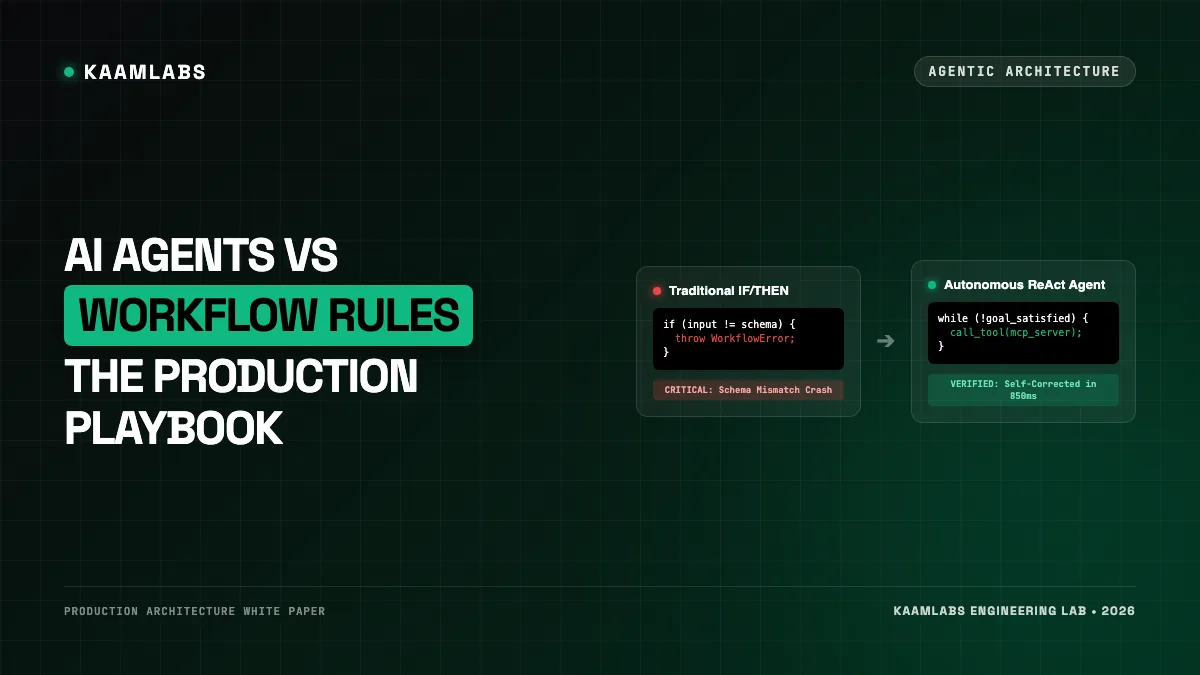
Traditional automation is deterministic: it follows rigid `IF/THEN` rules and fails when inputs deviate from expected schemas. An AI agent combines reasoning and tool-use: it understands natural language ambiguity, extracts semantic entities from unstructured documents, formulates execution plans, calls external APIs dynamically, and handles complex multi-step workflows autonomously.
Put this into a project brief
Describe the user task, the current bottleneck, the systems involved and how you will measure a successful result. Ask for a scoped pilot and acceptance checks before expanding the implementation.
Discuss a website project or explore published client work.
Essential Takeaways & Clarifications
Digital transformation focused on systems of record: moving paper processes to cloud SaaS and databases. AI transformation focuses on systems of intelligence and action: deploying autonomous agents and RAG to perform cognitive tasks, resolve customer inquiries, and execute ERP transactions autonomously.
Use this guidance in context
Technical examples are starting points for a project review. Platform requirements change, and results depend on implementation and starting conditions. Refer to the linked documentation and test the actual workflow.
Send a correction with the page URL to hello@kaamlabs.in.
Consult the source for current requirements and the context of each referenced statement.
Explore delivery details, project examples and practical buying guidance.
Ready to Upgrade to Sub-Second Modern Architecture?
Eliminate development delays. Ship clean Next.js, FastAPI, or mobile systems with dedicated engineering and milestone-driven delivery.
Related Engineering Deep-Dives
Autonomous AI Agents vs. Workflow Automation
Enterprise RAG Architecture in 2026
AI & AutomationEnterprise RAG Architecture in 2026