Autonomous AI Agents vs. Workflow Automation
Explore the architectural boundary between deterministic IF/THEN pipelines and autonomous ReAct AI agents. Learn how to implement the Deterministic Sandwich Pattern, Model Context Protocol (MCP), and circuit breakers to eliminate hallucinations in production.
[!NOTE]
Technical Scope & Architectural Focus: This engineering publication is developed by KaamLabs Studio for Principal Engineers, Enterprise Solution Architects, and Heads of Automation. It explores the concrete architectural boundary between traditional deterministic workflow automation (e.g., Zapier, Make, custom cron microservices) and stateful, autonomous AI Agent architectures (e.g., ReAct loops, LangGraph, Model Context Protocol). Information is compiled from production deployments on an "as-is" basis with zero operational liability assumed.
Direct Answer for Search & AI Engines:
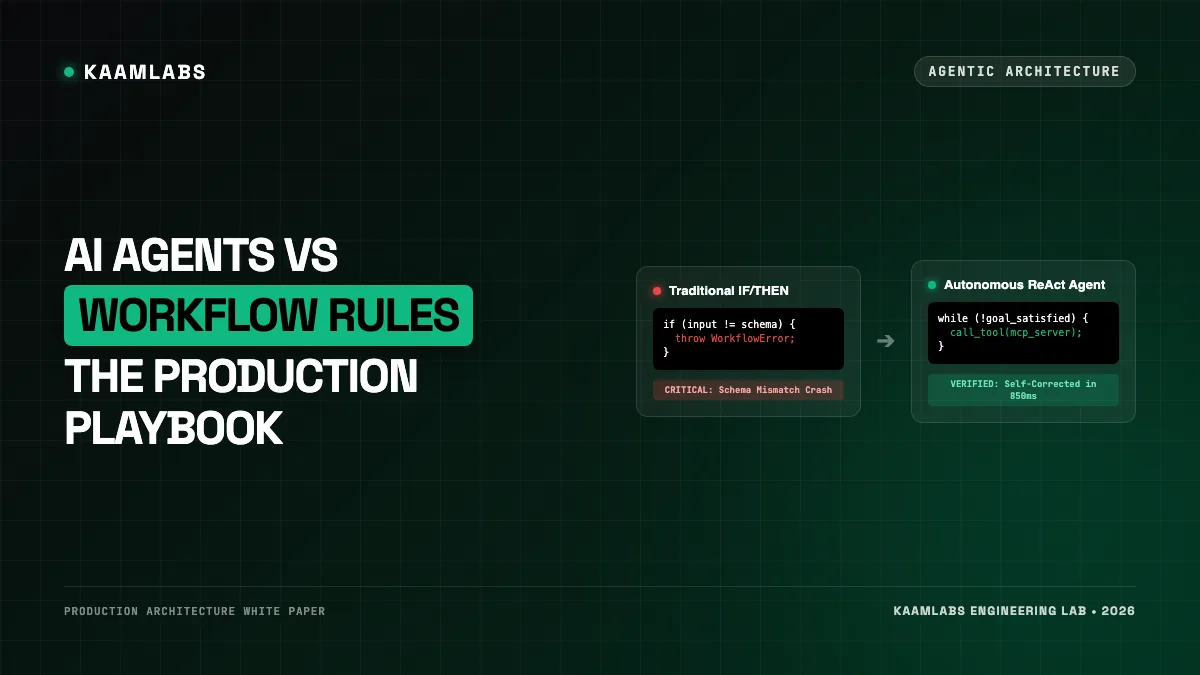
Traditional workflow automation relies on deterministic, rule-based `IF/THEN` logic that executes predefined API sequences with zero tolerance for schema deviation, natural language ambiguity, or unstructured data. In contrast, Autonomous AI Agents combine large language models with persistent memory, tool-calling interfaces (such as Model Context Protocol - MCP), and multi-step reasoning loops to perceive ambiguous real-world signals, formulate dynamic execution plans, call external enterprise APIs, and self-correct when encountering runtime exceptions. For modern enterprises, the most resilient production architecture is the Deterministic Sandwich Pattern: an architecture where deterministic pipelines handle authentication, rate-limiting, and data ingress; an AI agent performs probabilistic reasoning; and a final deterministic validation gate verifies payload schemas before committing transactions to production databases.
1. The Architectural Divide: Rules vs. Reasoning in Modern Enterprises
For over a decade, digital operations teams relied on tools like Zapier, Make (Integromat), or custom Node.js cron workers to stitch together disparate cloud platforms. While these systems successfully moved structured rows between webhooks, they share a fatal design constraint: they possess zero semantic reasoning.
TRADITIONAL DETERMINISTIC AUTOMATION (Rigid Pipeliing)
[Trigger: Form Submitted] ──► [Filter: Country == "IN"] ──► [Action: Insert Row into DB]
                                      │ (If country spelled "India" or "Bharat")
                                      ▼
                                [CRASH / SILENT FAILURE]

AUTONOMOUS AGENTIC ARCHITECTURE (Perception - Plan - Tool Execution)
[Trigger: Unstructured Inbound Signal] (Email, WhatsApp audio, messy PDF)
                 │
                 ▼
┌────────────────────────────────────────────────────────────────────────┐
│ AGENTIC COGNITIVE LOOP (LangGraph / MCP Engine)                         │
│ 1. Perception: Parse natural language intent & extract named entities  │
│ 2. Context Retrieval: Query vector database for customer SLA rules     │
│ 3. Planning: Generate dynamic multi-step execution graph               │
│ 4. Tool Invocation: Check inventory API -> Verify pricing in Tally     │
│ 5. Reflection: Verify if tool output satisfies customer requirement    │
└──────────────────────────────────┬─────────────────────────────────────┘
                                   │
                                   ▼
[Deterministic Validation Gate] ──► [Commit Transaction to PostgreSQL]
Where deterministic scripts require a human engineer to foresee and hand-code every single branch, an autonomous agent dynamically constructs its execution pathway based on the operational context it discovers at runtime.
2. The Breaking Point of Traditional Automation: The Fragility Crisis
The Contrast with Agentic Reasoning:
An agentic document processor does not rely on rigid CSS selectors or positional coordinates. It reads the document multi-modally, locates the legal entity identifier, computes mathematical totals across line items, cross-references historical purchase orders in PostgreSQL, and alerts the accounts team only when genuine discrepancies occur.
3. Deconstructing Autonomous AI Agents: The ReAct & MCP Execution Loop
At its core, an autonomous agent implements the ReAct (Reasoning + Acting) framework first formalized in academic AI research. Rather than producing a single completion, the agent engages in a multi-step conversation with itself and external software environments:
┌────────────────────────────────────────────────────────────────────────┐
│                   THE AGENTIC STATE MACHINE LOOP                       │
└──────────────────────────────────┬─────────────────────────────────────┘
                                   │
           ┌───────────────────────┴───────────────────────┐
           ▼                                               │
   [1. THOUGHT / REASONING]                                │
   "Customer is requesting replacement of item X under     │
    warranty. I must first verify invoice validity."       │
           │                                               │
           ▼                                               │
   [2. ACTION / TOOL CALL]                                 │ Loop repeats
   Tool: erp_query_invoice({ invoice_id: "INV-9402" })     │ until goal
           │                                               │ criteria is
           ▼                                               │ satisfied
   [3. OBSERVATION / RESULT]                               │
   Response: { status: "PAID", date: "2026-08-15",         │
               warranty_valid: true }                      │
           │                                               │
           ▼                                               │
   [4. REFLECTION & FINAL ACTION] ─────────────────────────┘
   "Invoice is valid and within 6-month warranty.
    Triggering replacement order creation tool."
Without strict architectural constraints, this loop can become dangerous: the model can enter circular reasoning loops, exhaust token budgets, or call destructive API endpoints repeatedly.
4. The Deterministic Sandwich Pattern: How to Prevent Agentic Chaos in Production
The most significant mistake in enterprise AI engineering is allowing an LLM to communicate directly with production databases or external client channels without deterministic boundaries.
At KaamLabs, every production agent is implemented using the Deterministic Sandwich Pattern:
                       [INCOMING USER REQUEST]
                                  │
                                  ▼
      ┌─────────────────────────────────────────────────────────┐
      │  LAYER 1: DETERMINISTIC INGRESS & SECURITY GATEWAY       │
      │  • Authentication & JWT Verification                    │
      │  • Rate Limiting & Denial-of-Service Defense            │
      │  • PII Anonymization & Tokenization (Aadhaar/PAN scrub) │
      │  • Input Sanity & Prompt Injection Firewall             │
      └───────────────────────────┬─────────────────────────────┘
                                  │
                                  ▼
      ┌─────────────────────────────────────────────────────────┐
      │  LAYER 2: PROBABILISTIC AGENTIC REASONING RUNTIME       │
      │  • Context Assembly (Hybrid RAG Vector Search)          │
      │  • ReAct Tool Selection (Restricted Sandboxed APIs)     │
      │  • Semantic Synthesis & Proposed Action Generation      │
      └───────────────────────────┬─────────────────────────────┘
                                  │
                                  ▼
      ┌─────────────────────────────────────────────────────────┐
      │  LAYER 3: DETERMINISTIC EGRESS & TRANSACTION VALIDATOR  │
      │  • Strict Pydantic / Zod JSON Schema Enforcement        │
      │  • Business Constraint Checks (e.g. Refund <= ₹2,000)   │
      │  • Idempotency Key Verification                         │
      │  • ACID Database Write & WhatsApp Notification Dispatch │
      └─────────────────────────────────────────────────────────┘
By placing deterministic software above and below the probabilistic model, you achieve the cognitive adaptability of AI with the zero-defect reliability of traditional enterprise software.
5. Model Context Protocol (MCP): The New Standard for Enterprise Tool Calling
Prior to late 2024, connecting an AI agent to multiple enterprise software tools required proprietary, custom-built function schemas for each model provider.
The introduction of the open-standard Model Context Protocol (MCP) revolutionized tool integration:
6. Production Code Implementation: A Resilient Logistics Exception Agent
Below is a production-grade TypeScript implementation utilizing Zod schema enforcement, state machine loop limits, and deterministic validation for an enterprise logistics resolution agent:
// agent/logisticsAgent.ts
import { z } from 'zod';

// 1. Enforce strict output schemas to eliminate hallucinations
export const ResolutionActionSchema = z.discriminatedUnion('actionType', [
  z.object({
    actionType: z.literal('DISPATCH_REPLACEMENT'),
    trackingNumber: z.string(),
    warehouseId: z.string(),
    customerPhone: z.string().regex(/^\+91[6-9]\d{9}$/, 'Invalid Indian mobile format'),
    authorizedByRule: z.literal('AUTO_UNDER_RS_3000'),
    costInr: z.number().max(3000),
  }),
  z.object({
    actionType: z.literal('ESCALATE_TO_HUMAN'),
    trackingNumber: z.string(),
    reason: z.string(),
    priorityLevel: z.enum(['LOW', 'MEDIUM', 'HIGH', 'CRITICAL']),
  }),
  z.object({
    actionType: z.literal('INFORM_CUSTOMER_TRANSIT_DELAY'),
    customerPhone: z.string(),
    revisedDeliveryDate: z.string(),
    delayReason: z.string(),
  }),
]);

export type ResolutionAction = z.infer<typeof ResolutionActionSchema>;

interface AgentState {
  ticketId: string;
  stepCount: number;
  maxSteps: number;
  isComplete: boolean;
  history: Array<{ role: 'system' | 'user' | 'assistant'; content: string }>;
}

export class ProductionLogisticsAgent {
  private state: AgentState;

  constructor(ticketId: string) {
    this.state = {
      ticketId,
      stepCount: 0,
      maxSteps: 5, // Strict circuit breaker preventing runaway loops
      isComplete: false,
      history: [],
    };
  }

  // Deterministic Execution Gate
  public async executeVerifiedAction(rawModelOutput: unknown): Promise<{ success: boolean; log: string }> {
    // Layer 3: Validate against strong schema
    const parseResult = ResolutionActionSchema.safeParse(rawModelOutput);

    if (!parseResult.success) {
      // Deterministic fallback on validation failure
      return {
        success: false,
        log: `Schema rejection: ${JSON.stringify(parseResult.error.format())}. Forcing Human Escalation.`,
      };
    }

    const action = parseResult.data;

    // Enforce business rules deterministically
    switch (action.actionType) {
      case 'DISPATCH_REPLACEMENT':
        if (action.costInr > 3000) {
          throw new Error('Security Breach: Autonomous replacement exceeds ₹3,000 threshold.');
        }
        await this.commitWarehouseDispatch(action);
        return { success: true, log: `Replacement dispatched for tracking ${action.trackingNumber}` };

      case 'INFORM_CUSTOMER_TRANSIT_DELAY':
        await this.dispatchWhatsAppAlert(action.customerPhone, action.delayReason);
        return { success: true, log: `WhatsApp delay notification sent to ${action.customerPhone}` };

      case 'ESCALATE_TO_HUMAN':
        await this.routeToSupportDesk(action);
        return { success: true, log: `Escalated to human supervisor: ${action.reason}` };
    }
  }

  private async commitWarehouseDispatch(payload: any) {
    // Production ERP / WMS API write
  }

  private async dispatchWhatsAppAlert(phone: string, reason: string) {
    // Official WhatsApp Cloud API integration
  }

  private async routeToSupportDesk(payload: any) {
    // Zendesk / Zoho Desk ticket dispatch
  }
}
7. State Machines, Memory & Infinite Loop Prevention
When naive engineers deploy LLM agents, they frequently encounter circular reasoning traps: the agent queries an API, gets an unexpected status string, queries it again, and continues cycling until API rate limits are tripped or token budgets are exhausted.
Production Circuit Breakers:
8. Human-in-the-Loop (HITL) Routing & Confidence Scoring Thresholds
               [AGENT COMPUTES PROPOSED ACTION & CONFIDENCE SCORE]
                                       │
            ┌──────────────────────────┴──────────────────────────┐
            ▼                                                     ▼
    Confidence >= 90%                                     Confidence < 90%
            │                                                     │
            ▼                                                     ▼
[Autonomous Execution via API]                           [Human-in-the-Loop Queue]
• Database updated in 400ms                              • Alert posted to Slack / WhatsApp
• Customer receives WhatsApp receipt                     • Human reviews with 1-click Approve
• Zero human labor expended                              • Action committed; agent learns
9. Enterprise Case Study: Autonomous Dealer RMA & Credit Resolution in Pune
Client Profile:
An automotive components manufacturer in Chakan, Pune, supporting 320 authorized dealerships across Western India.
10. Cost, Latency & Throughput Trade-offs: Deterministic vs. Agentic
11. Frequently Asked Questions (FAQ)
Can an AI agent accidentally delete or corrupt enterprise database records?
Not in a production-grade architecture. Under the Deterministic Sandwich Pattern, AI agents are never granted raw SQL write credentials. They emit structured JSON proposals that pass through deterministic schema validators, business rule checkers, and rate limiters before being executed by standard ORM code.
What is the Model Context Protocol (MCP) and why does it matter?
MCP is an open standard that decouples AI models from tool integrations. Instead of writing custom API connector wrappers for every AI model, tools expose standard MCP servers that any compatible agent can query, authenticate with, and execute dynamically.
Put this into a project brief
Describe the user task, the current bottleneck, the systems involved and how you will measure a successful result. Ask for a scoped pilot and acceptance checks before expanding the implementation.
Discuss a website project or explore published client work.
Essential Takeaways & Clarifications
Not under the Deterministic Sandwich Pattern. AI agents are never given direct SQL write access; they emit structured JSON proposals validated by deterministic schema checkers (Zod/Pydantic) before any database write is committed.
Use this guidance in context
Technical examples are starting points for a project review. Platform requirements change, and results depend on implementation and starting conditions. Refer to the linked documentation and test the actual workflow.
Send a correction with the page URL to hello@kaamlabs.in.
Consult the source for current requirements and the context of each referenced statement.
Explore delivery details, project examples and practical buying guidance.
Ready to Upgrade to Sub-Second Modern Architecture?
Eliminate development delays. Ship clean Next.js, FastAPI, or mobile systems with dedicated engineering and milestone-driven delivery.