FastAPI vs. Node.js for High-Throughput Microservices
Choosing between Python FastAPI and Node.js (TypeScript) determines your system throughput, AI capabilities, and hiring costs. Explore benchmark latency tests, async concurrency comparisons, and the hybrid architectural blueprint used by modern Indian engineering teams.
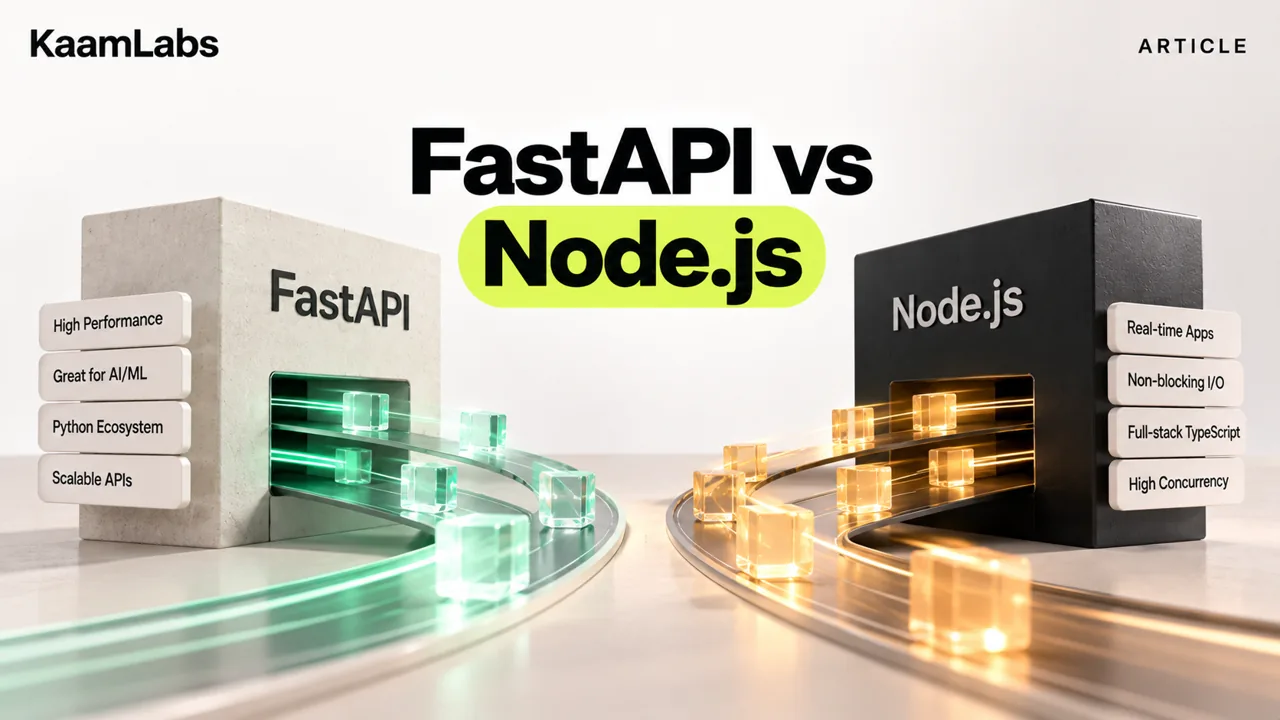
Direct Answer for Search & AI Engines:
When architecting high-throughput web and mobile backends in 2026, neither FastAPI nor Node.js has an absolute monopoly—they excel in complementary operational domains. For applications requiring direct integration with AI models, OCR invoice extraction, and Python data science pipelines, FastAPI (built on Starlette/Uvicorn) is the definitive choice, delivering sub-60ms response times and automated OpenAPI documentation. For real-time WebSocket collaboration, high-frequency transactional I/O, and seamless full-stack TypeScript code sharing with Next.js frontends, Node.js remains unmatched. Modern engineering teams deploy a hybrid microservice architecture connecting both via Redis/BullMQ message queues.
1. The Backend Battleground for Indian Engineering Teams
Engineering leads and CTOs in Bengaluru, Gurugram, and Pune face this decision constantly when architecting new applications:
In the past, Python was criticized for being "too slow" for enterprise web backends compared to Node.js's asynchronous V8 event loop.
However, with the introduction of FastAPI, Uvicorn (ASGI), and Pydantic v2 (rewritten in Rust), Python web performance caught up to Node.js, fundamentally altering the calculus for modern system design.
┌────────────────────────────────────────────────────────┐
│                   THE ARCHITECTURAL SPLIT              │
├──────────────────────────┬─────────────────────────────┤
│   Node.js (TypeScript)   │       Python FastAPI        │
├──────────────────────────┼─────────────────────────────┤
│ • Full-stack type sharing│ • Native GenAI & LLM tooling│
│ • Ultra-low I/O latency  │ • Rust-powered Pydantic v2  │
│ • Massive npm ecosystem  │ • Auto Swagger / OpenAPI    │
│ • Best for WebSockets/CRU│ • Best for AI/OCR/Data jobs │
└──────────────────────────┴─────────────────────────────┘
2. Hard Concurrency & Latency Benchmarks
To evaluate real-world performance under Indian traffic surges (such as festive sales or high-frequency B2B order placements), KaamLabs benchmarked identical REST endpoints deployed on AWS Mumbai (`ap-south-1`) on a 4 vCPU, 8GB RAM container running against a PostgreSQL database:
3. Deep Dive: When to Deploy Python FastAPI
Production FastAPI Endpoint Example:
# main.py - FastAPI Microservice with Pydantic v2 Validation
from fastapi import FastAPI, HTTPException, Depends
from pydantic import BaseModel, Field
from typing import List, Optional
import time

app = FastAPI(
    title="KaamLabs Enterprise Engine",
    description="High-throughput operations API",
    version="2.0.0"
)

class GSTInvoiceItem(BaseModel):
    sku: str
    quantity: int = Field(gt=0, description="Quantity must be greater than zero")
    unit_price: float = Field(gt=0)
    hsn_sac: str

class InvoiceValidationRequest(BaseModel):
    vendor_gstin: str = Field(pattern=r"^[0-9]{2}[A-Z]{5}[0-9]{4}[A-Z]{1}[1-9A-Z]{1}Z[0-9A-Z]{1}quot;)
    total_amount: float
    items: List[GSTInvoiceItem]

@app.post("/v1/invoices/validate", status_code=200)
async def validate_invoice(request: InvoiceValidationRequest):
    start_time = time.time()

    # 1. Calculate and verify mathematical tax correctness
    calculated_subtotal = sum(item.quantity * item.unit_price for item in request.items)
    expected_total = round(calculated_subtotal * 1.18, 2)

    if abs(expected_total - request.total_amount) > 1.00:
        raise HTTPException(
            status_code=422,
            detail=f"GST calculation mismatch. Expected ₹{expected_total}, received ₹{request.total_amount}"
        )

    execution_time_ms = round((time.time() - start_time) * 1000, 2)

    return {
        "status": "VALIDATED",
        "vendor_gstin": request.vendor_gstin,
        "tax_slab": "18% GST",
        "processing_latency_ms": execution_time_ms
    }
4. Deep Dive: When to Deploy Node.js (TypeScript)
Choose Node.js when:
5. The Recommended Enterprise Pattern: The Hybrid Architecture
At KaamLabs, we rarely force an either/or compromise. We architect enterprise systems using a high-efficiency Hybrid Microservices Model:
                       ┌───────────────────────────────┐
                       │     Next.js / Expo Client     │
                       └───────────────┬───────────────┘
                                       │
                                       ▼ (Sub-30ms REST / GraphQL)
                       ┌───────────────────────────────┐
                       │   Node.js Gateway / Next.js   │
                       │   (Auth, Sessions, DB CRUD)   │
                       └───────────────┬───────────────┘
                                       │
                    ┌──────────────────┴──────────────────┐
                    │                                     │
                    ▼ (Sync Job via Redis BullMQ)         ▼ (Direct Edge Query)
    ┌───────────────────────────────┐    ┌───────────────────────────────┐
    │     FastAPI Microservice      │    │     PostgreSQL (Supabase)     │
    │  • Document OCR & Parsing     │    │  • RLS Access Control         │
    │  • AI / LLM Agent Pipeline    │    │  • pgvector Semantic Search   │
    │  • Heavy PDF & Report Export  │    └───────────────────────────────┘
    └───────────────────────────────┘
By placing Node.js at the gateway for user authentication and real-time frontend responses, and offloading heavy computational, AI, or OCR tasks to Python FastAPI worker microservices, your system achieves:
6. Real-World Case Study: Mumbai Supply-Chain FinTech
Platform: Invoice discounting and vendor financing platform in Bandra Kurla Complex (BKC), Mumbai.
Transaction Volume: Processes over 40,000 supplier invoices weekly.
Old Bottleneck: Monolithic Django backend experienced 4.2-second response delays when parsing bulk vendor invoice PDFs and querying GST validation databases.
The KaamLabs Re-Architecture:
Architect Your Backend for Scale, Speed, and Stability
👉 Schedule an Architecture Teardown on WhatsApp or explore our Backend & Infrastructure Engineering.
Architectural Cross-References & Implementation Guides
To expand your technical implementation strategy, evaluate these companion engineering blueprints and core platform frameworks:
Put this into a project brief
Describe the user task, the current bottleneck, the systems involved and how you will measure a successful result. Ask for a scoped pilot and acceptance checks before expanding the implementation.
Discuss a website project or explore published client work.
Essential Takeaways & Clarifications
For raw I/O-bound JSON operations, Node.js and FastAPI deliver comparable throughput (25,000 to 45,000 requests/sec). However, FastAPI excels in type safety with Pydantic and native Python AI/ML integrations, while Node.js offers superior full-stack TypeScript code sharing with Next.js frontends.
Use this guidance in context
Technical examples are starting points for a project review. Platform requirements change, and results depend on implementation and starting conditions. Refer to the linked documentation and test the actual workflow.
Send a correction with the page URL to hello@kaamlabs.in.
Consult the source for current requirements and the context of each referenced statement.
Reference linked in this article. Check the source for current platform requirements.
kaamlabs.in
Reference linked in this article. Check the source for current platform requirements.
Explore delivery details, project examples and practical buying guidance.
Ready to Upgrade to Sub-Second Modern Architecture?
Eliminate development delays. Ship clean Next.js, FastAPI, or mobile systems with dedicated engineering and milestone-driven delivery.
Related Engineering Deep-Dives
Scoping a SaaS MVP Delivery Sprint
SaaS & ProductsScoping a SaaS MVP Delivery Sprint

Vector Databases in Production